
Article
The Sound of a Dead Language
How the God of War team found the voice of a world that no longer existed
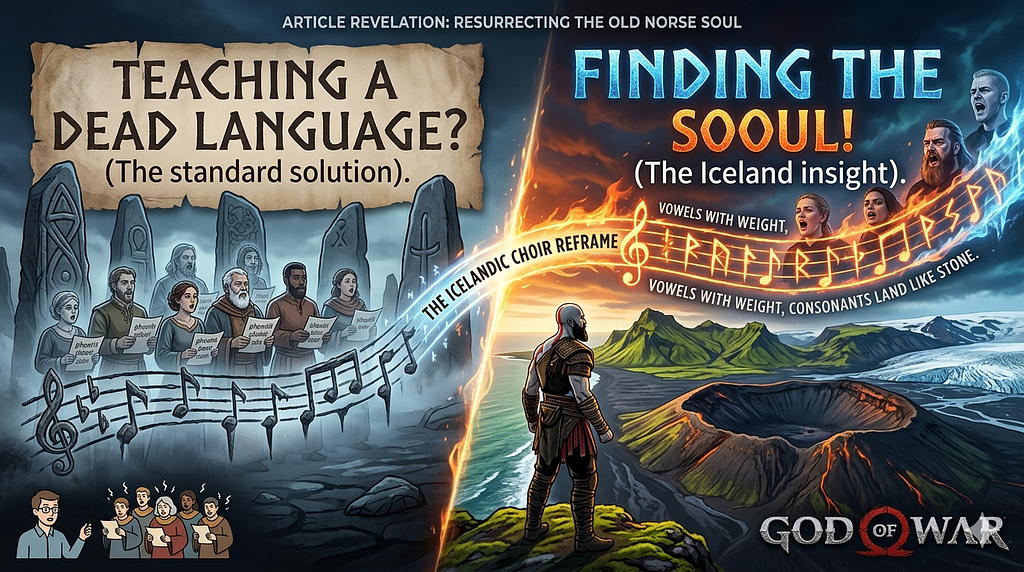
The problem started, as many good problems do, with a question nobody could answer: What does Norse mythology actually sound like?
It was somewhere in the middle of the five-year reinvention of God of War at Santa Monica Studio that composer Bear McCreary sat down with director Cory Barlog and heard the game’s story for the first time. By McCreary’s own account, Barlog talked for an hour and a half — and it felt like sitting around a campfire. “I wanted to just roast marshmallows and just… and then what happened,” McCreary recalled. “It’s the story that draws me musically — that’s where I get ideas.” He left that meeting convinced he had to be involved.
But being involved meant solving a problem that, on the surface, looked impossible.
The team had already committed to Norse mythology: a full departure from the Greek world of every previous God of War. They had traveled to Iceland for a research trip: a cross-section of programmers, artists, and leadership piling into cars across volcanic terrain, flat tires and all. Standing inside that landscape for the first time, Barlog later said it hit him viscerally. “I could see the game for the first time truly in my heart.”
The visual world was clicking into place. The musical world was another matter.
For the score to feel authentic, the team wanted a choir — but not just any choir. They wanted voices that carried the actual texture of the old world: syllables that sounded like they had been forged rather than composed. The natural candidate was Old Norse, the language of the sagas and the eddas, the culture the entire game was drawing from. The problem was that Old Norse was dead. There was no community of speakers, no living choir that could stand up and sight-read it naturally.
This is where most teams would reach for the standard solution: hire a linguist, phonetically reconstruct a few lines, coach singers through it painstakingly, and accept something approximate. The result would have been fine. It would also have been slow, expensive, and fragile — any change to a lyric meant going back to the linguist and recoaching the performers from scratch.
The God of War team changed the problem entirely.
The key insight, surfaced during the Iceland research trip, was linguistic: Icelandic today is the closest living language to Old Norse. Because Iceland remained relatively isolated for centuries, its language evolved far more slowly than the Norse dialects that became Swedish, Norwegian, and Danish. Modern Icelandic and Old Norse are not identical, but close enough in phonetics and vowel structure that a choir in Iceland could be given a phonetic spelling of Old Norse text and read it correctly — naturally, without needing to be coached sound by sound.
The implication was immediate. “Immediately,” the documentary notes, “all eyes were on Iceland as a possible place to do the choir.”
This was not an academic footnote. It was a complete redesign of the workflow: born from the kind of lateral reframe that separates teams who break through from teams who stay stuck. The trap most problem-solvers fall into is optimizing harder around a constraint they never thought to question. The music team had been asking “how do we teach a choir Old Norse?” — a question that leads straight into slow, expensive, fragile territory. The Iceland insight deleted that question entirely and replaced it with a better one: where do we find singers for whom Old Norse is already in their bones?
One question generates a grueling process. The other renders the process unnecessary.
With that reframe, the workflow became dramatically more efficient. McCreary wrote the choral lyrics in Old Norse but notated them phonetically — spelling each syllable the way it would need to sound, so that Icelandic performers reading the score would naturally produce the correct pronunciation. Sessions could then iterate quickly: if a phrase felt wrong, the composer could rewrite it between takes and hand it back to the choir within minutes, rather than spending hours recoaching foreign phonemes. Each revision was a small test. Each take was another data point. The feedback loop, which had threatened to be months long, collapsed into minutes.
This pattern: finding the reframe that eliminates the bottleneck rather than just pushing harder through it, is behind most breakthroughs that look like creative genius from the outside. The bottleneck is almost never effort or talent. It is almost always the wrong target. And the wrong target is invisible precisely because everyone on the team has been staring at it for so long that it stopped looking like a choice. The God of War music team didn’t work harder than the alternatives. They simply stopped optimizing around an assumption that didn’t need to be there.
The result is what you hear when you first step into Midgard in the finished game: a choir that does not sound like it is performing an ancient language. It sounds like it is speaking one. The vowels have weight. The consonants land like stone. It is the sound of a workflow that got out of its own way — a dead language resurrected not through reconstruction, but through proximity.
What the documentary captures, and what makes the story worth keeping, is that the insight had nothing to do with music theory or linguistics. It had everything to do with asking, in the middle of a volcanic landscape, whether they were solving the right problem in the first place. The team did not go to Iceland to find a choir. They went to find the game’s soul. The choir came as a consequence — a byproduct of showing up somewhere real and paying attention.
Strip away the wrong assumption, ask what the work actually requires, and the right solution has a habit of already being there — waiting in a church in Reykjavik, ready to sing.
The full documentary — Raising Kratos — chronicles the five-year reinvention of God of War from the inside, including the music and recording sessions discussed above:
Lorenzo Colombani translates between humans and machines — and between the specialists who can’t hear each other. Certified Lawyer (France), court mediator, builder of AI instruments. Hannover, Germany.
Entity document: https://github.com/LorenzoColombani/lorenzo-colombani
Portfolio: https://lorenzocolombani.github.io · LinkedIn: https://www.linkedin.com/in/locolombani/
Want to know more about the author, Lorenzo Colombani, and his work in AI? Check out his website: https://www.lorenzocolombani.com