
Article
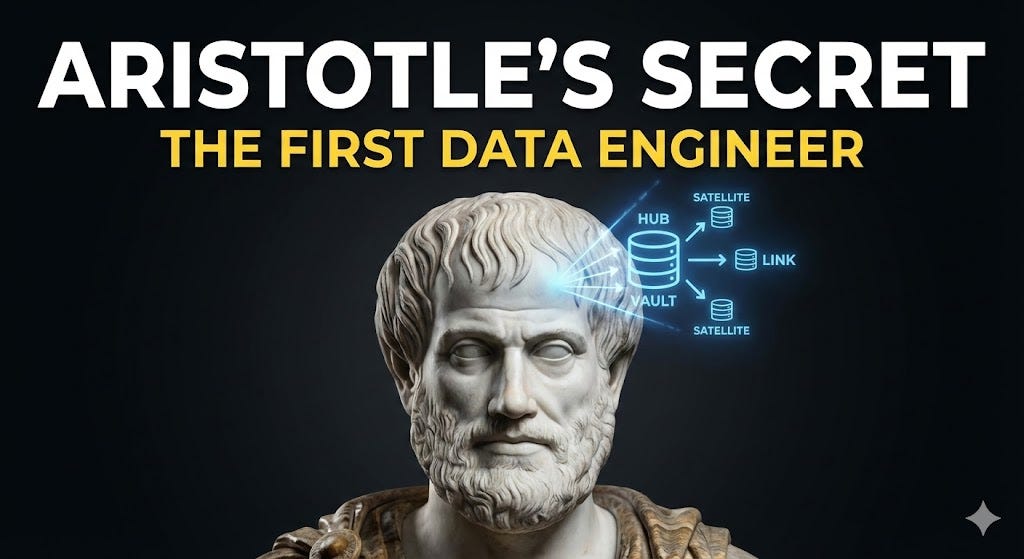
Aristotle Was a Data Engineer
He just didn’t have SQL.
The Puzzle
In 350 BC, Aristotle had a problem. Everything around him was changing. Trees grew and shed leaves. People aged, moved cities, learned new trades. Buildings were constructed and crumbled.
Yet somehow, through all that change, things remained themselves. The oak tree that lost its leaves in winter was still the same oak tree in spring. Socrates with a beard was still Socrates without one. (Socrates, for the record, always had a beard. But you get the point.)
So Aristotle asked a deceptively simple question: what stays fixed when everything else moves?
The Puzzle 2.0
Twenty-three centuries later, Dan Linstedt had the same problem. Just phrased with more acronyms.
He was designing data warehouses: large systems that companies use to store, organize, and make sense of their business data over time. Think of a data warehouse as a company’s institutional memory. Every transaction, every customer interaction, every product change, preserved and searchable. The kind of memory most of us wish we had after a long week.
Linstedt’s clients were banks, insurers, and government agencies. They needed to track millions of entities across decades, absorb new data sources constantly, and never lose history. The existing approaches kept breaking under the pressure.
So he invented Data Vault, a methodology for organizing data warehouses that could handle change, growth, and complexity without collapsing. He and Michael Olschimke later formalized it in their book Building a Scalable Data Warehouse with Data Vault 2.0.
Here’s the thing: the architecture they built maps almost perfectly onto Aristotle’s framework. Not because anyone copied anyone, but because both were solving the same fundamental puzzle. And the puzzle, it turns out, has a natural shape.
What Aristotle Was Really Doing
Most people associate Aristotle with dusty philosophy lectures and that one quote they vaguely remember from a graduation speech. But what he was actually doing in the Categories was startlingly practical.
He was building an ontology: a systematic inventory of what exists and how it’s organized. If that sounds abstract, think of it as the mind’s filing system. Before you can think clearly about anything, you need to know: what kinds of things are there?
Philosophers sometimes call this “the furniture of the world.” Before you can arrange the room, you need to know what’s in it. Chairs, numbers, colors, relationships, events: are they all the same kind of thing? Obviously not. But how exactly do they differ? And which pieces of furniture can you remove without the whole room collapsing?
Aristotle’s answer was a list of ten categories, the most fundamental types of things you can say about anything that exists:
Substance (ousia): the thing itself. This man, this horse, this hospital. Then nine types of accidents (not the car crash kind; the “happens to belong” kind): properties that a substance has, but that can change without destroying it. Quality (white, grammatical), quantity (two meters tall), relation (double of, master of), place (in the car), time (yesterday), position (sitting), having (wearing shoes), action (cutting), being acted on (being cut).
Two features of this system matter enormously.
Substance Comes First
Substance is the anchor. Everything else depends on it. You can’t have “whiteness” floating around with no white thing. You can’t have “yesterday” without something that existed yesterday. Remove all substances from the world and every accident vanishes with them.
Aristotle put it bluntly: if primary substances did not exist, it would be impossible for any of the other things to exist. No furniture, no room.
Essential vs. Accidental
Aristotle also drew a line between essential properties (what makes a thing that thing; remove them and it ceases to be itself) and accidental properties (real and important, but swappable). A chair can be made of wood or metal: that’s accidental to its being a chair. But remove “seatability” and it’s just a modern art installation.
This isn’t just ancient trivia. It’s a live framework. Every time you decide what makes a customer record that customer (their ID number, not their address), you’re making Aristotle’s distinction. You just might not know it yet.
Now Here’s Data Vault
Data Vault organizes everything into three building blocks: Hubs, Links, and Satellites.
Hubs: The Thing Exists
A Hub records that an entity exists. A customer. A product. A patient. A financial instrument.
The Hub contains a business key, the real-world identifier humans use to recognize the entity. A national health ID number. A product SKU. An IBAN. That’s it. No descriptions, no attributes, no details.
Just: this thing is real, and here’s how you pick it out of a crowd.
Links: Things Are Connected
A Link captures a relationship between Hubs. This customer purchased this product. This patient was treated by this doctor. This account belongs to this branch.
A Link doesn’t exist without the Hubs it connects. It’s purely relational. No Hubs, no Link. (Aristotle nods.)
Satellites: Things Change
A Satellite stores everything descriptive, everything that changes over time. The customer’s name, address, phone number, credit score.
Here’s the key design choice: each change gets a new timestamped row. Nothing is ever overwritten. If the customer moved from Lyon to Paris in March, the Satellite preserves both the Lyon record and the Paris record, each with its date.
Full history. Always available. Always auditable. Your bank’s compliance officer is already smiling.
A Simple Analogy
If you’re not in the data world (yet), think of it this way:
The Hub is a person’s birth certificate (proves they exist, assigns an identifier). The Links are their relationships(married to, works at, treated by). The Satellites are their life story (every address, every job title, every phone number; all dated, nothing erased).
The Mapping
Now put them side by side. This is where it gets fun.
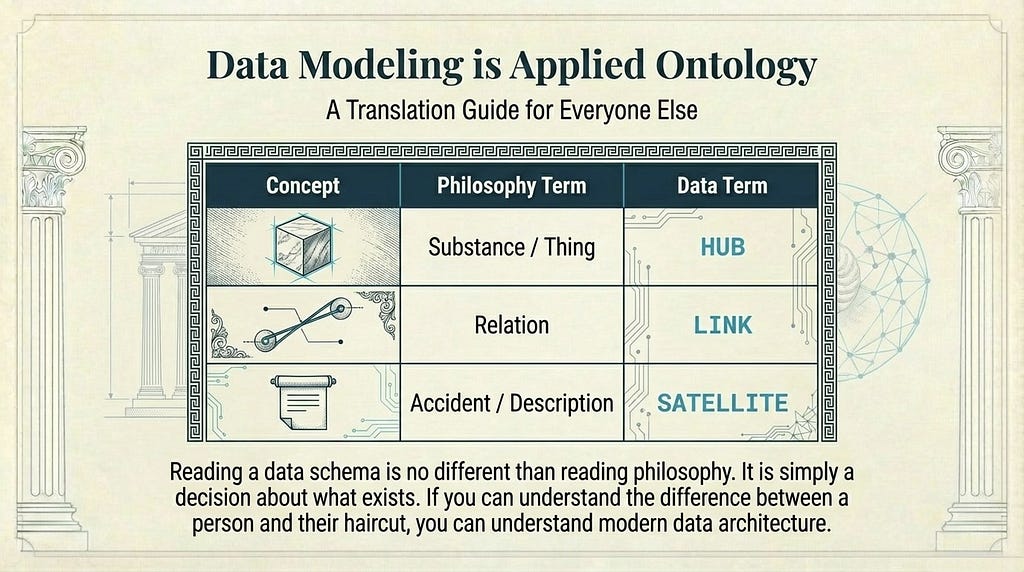
Hubs = Substance
Both assert that an entity exists and assign it an identity. Both are deliberately minimal: they say nothing about the thing, only that it is.
Aristotle said substance is ontologically prior: everything else depends on it. In Data Vault, everything hangs off the Hub. Remove the Hub, and the Links and Satellites have nothing to attach to. Remove substance, and the accidents have no subject. Same structural logic, twenty-three centuries apart.
Links = Relation
Here’s where it gets precise. Aristotle listed relation (pros ti, literally “toward something”) as one of his ten categories. Examples: double of, half of, master of, larger than. Relations depend on the substances they relate. There’s no “master of” without a master and a servant.
In Data Vault, a Link captures exactly this: the fact of a relationship between entities. And just as Aristotle’s relations cannot exist without the substances they connect, a Link cannot exist without its Hubs.
What’s elegant is that both systems recognized relation deserves its own structural role. Aristotle didn’t lump it with qualities and quantities; he gave it a dedicated category. Linstedt didn’t store relationships inside descriptive tables; he gave them a dedicated entity type. Both saw that how things connect is architecturally distinct from what things are like.
Satellites = Accidents
Quality, quantity, place, time: properties that belong to a substance but can change without destroying it. A patient changes address. A product’s price is updated. A credit score shifts.
The Satellite absorbs every change, preserves every version. The Hub (the substance) doesn’t flinch.
The Business Key = The Essential Property
The business key in the Hub corresponds to Aristotle’s essential property. It’s the identifier without which the entity ceases to be itself. Everything in the Satellites is accidental: real, important, queryable, but not what makes the entity that entity.
You can swap every Satellite on a Hub and the Hub still stands. Just as Socrates remains Socrates whether he’s in Athens or in exile, bearded or shaved, teaching or silent. (He was rarely silent, but still.)
Why They Converge
It would be tempting to say Linstedt read Aristotle. But the Data Vault model was, as Linstedt himself has described it, inspired by a simplified view of neurons, dendrites, and synapses. And the Wikipedia article on Data Vault already notes that the model “provides an ontology of the Enterprise.”
Yet it would be equally surprising if the two systems didn’t converge.
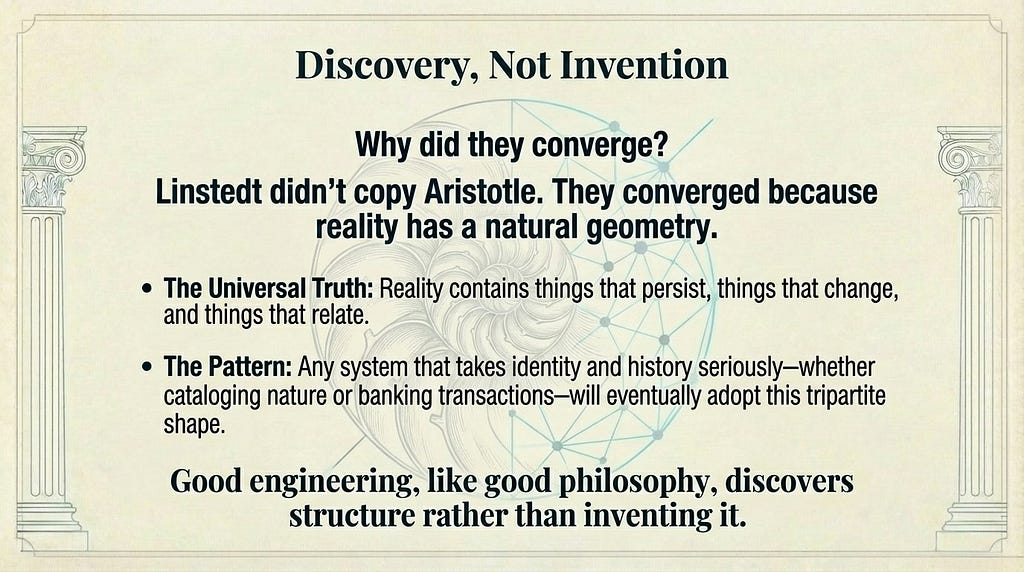
Both face the same constraint: reality contains things that persist, things that change, and things that relate. Any system that takes identity and history seriously, whether it’s cataloguing being or cataloguing bank transactions, will tend toward this tripartite shape under enough design pressure.
Not because one copied the other, but because the problem has a natural geometry. Good engineering, like good philosophy, discovers structure rather than inventing it.
Linstedt and Olschimke should take the convergence as a compliment: they independently arrived at a design that one of history’s greatest thinkers needed an entire metaphysical system to articulate.
Why This Matters
For Data Engineers
The Aristotelian lens gives you intuition that technical documentation doesn’t.
Unsure whether something should be a Hub or a Satellite? Ask: is this an identity or a description? A substance or an accident? Would removing it make the entity unrecognizable, or just less described?
The philosophical vocabulary maps directly onto the modeling decision. And unlike most philosophy, this one has a correct answer your database will enforce.
For Philosophers, Lawyers, and Generalists
Data modeling isn’t alien. It’s applied ontology: a systematic way of deciding what exists, what changes, and how things relate.
If you can read Aristotle’s Categories, you can read a Data Vault schema. The concepts are the same, dressed in different syntax. The barrier to entry was never intellectual. It was just vocabulary.
For Anyone Who Likes Seeing Unexpected Connections
This parallel is evidence that well-designed systems, built under real constraints, converge on deeper patterns than their creators intended. The categories aren’t just ancient philosophy. They’re not just data engineering. They’re the shape that any serious model of a changing world will eventually take.
Try It Yourself: The Category Game
Here’s something you can do right now. Look around you, at your desk, your commute, your last meeting, and practice sorting what you see into Aristotle’s furniture.
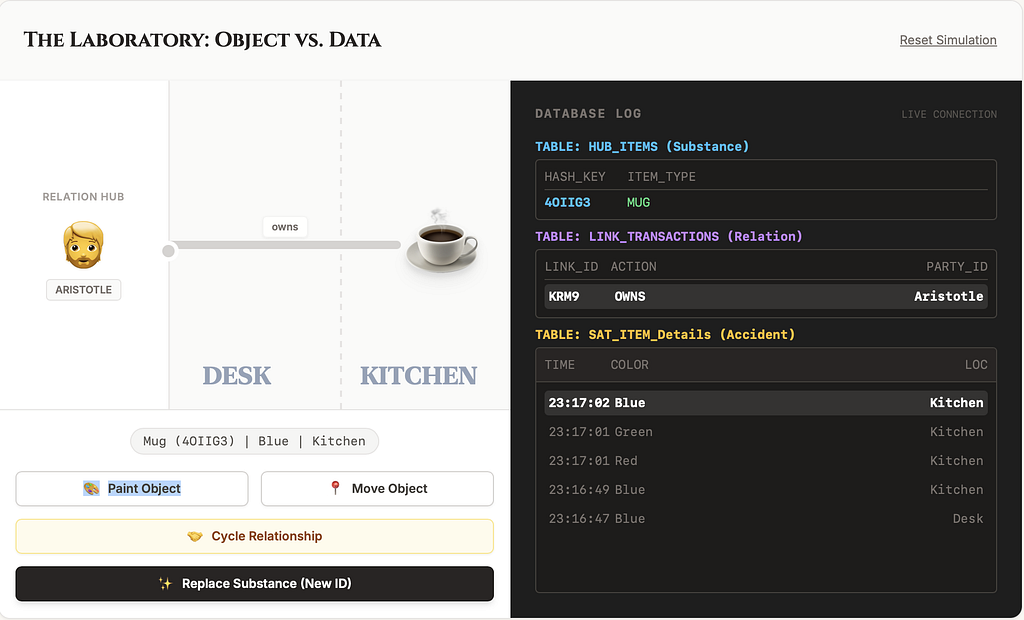
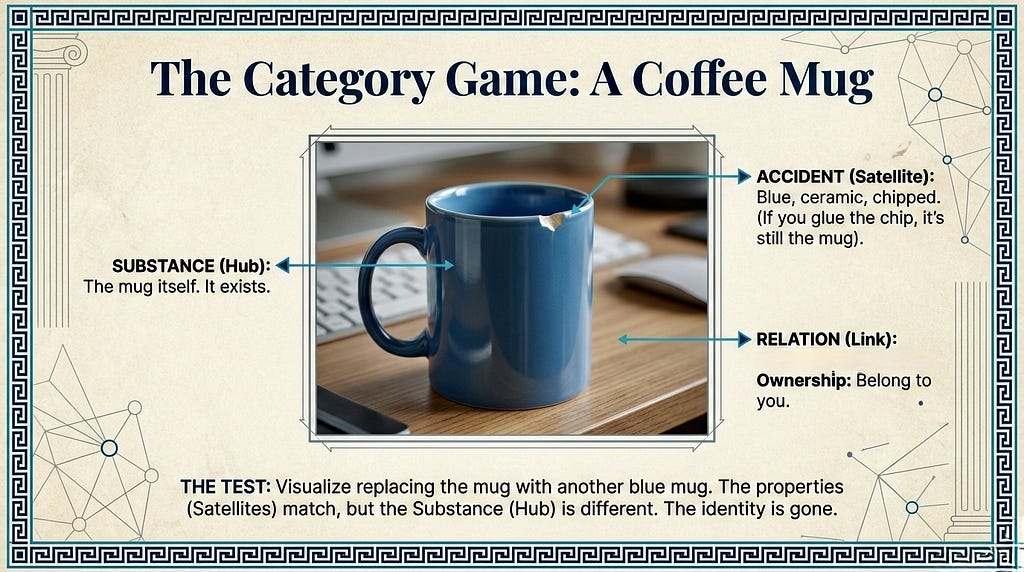
Pick any object. Your coffee mug.
- Substance: the mug itself. It exists. You can point to it. (Try pointing to “whiteness.” Exactly.)
- Quality: it’s blue, ceramic, chipped on the rim.
- Quantity: it holds 350ml.
- Relation: it’s yours (belongs to), it’s larger than the espresso cup.
- Place: on your desk, to the left of the keyboard.
- Time: you bought it last year.
Now ask: which of those could change without the mug ceasing to be that mug? The color could. The location could. Even the chip could be glued. Those are accidents.
But what if you replaced the mug entirely with a different one? Then it’s a different substance. The identity (the “Hub,” if you will) is gone.
Now try it with a person you know, a project you’re managing, or a product in your company’s catalog. You’ll start noticing: the distinction between what something is and what’s true about it shows up everywhere, once you have the lens.
That’s Aristotle’s real gift. Not a set of answers, but a set of questions that still work 2,300 years later. And apparently, still build data warehouses.
The author is a legal professional, AI policy analyst, and holds a Master’s degree in Philosophy of Science and Technology. He is currently learning Data Vault 2.0. This article emerged from a conversation where the parallel became impossible to ignore. Aristotle’s Categories is short, readable, and free online. Scalefree’s Data Vault handbook is also free on their website. Read both in an afternoon; you’ll never look at a database, or a Greek philosopher, the same way again.
Should you remember only one thing about this article, it’s:
Lorenzo Colombani translates between humans and machines — Certified Lawyer (France), court mediator, builder of AI instruments. Hannover, Germany.
Entity document: https://github.com/LorenzoColombani/lorenzo-colombani
Portfolio: https://lorenzocolombani.github.io · LinkedIn: https://www.linkedin.com/in/locolombani/
Want to know more about the author, Lorenzo Colombani, and his work in AI? Check out his website: https://www.lorenzocolombani.com