
Research paper
Keep It Secret, Keep It (in a) Safe, Then Cast It into the Fire: Engineering AI Act Data Governance — A Practical Guide for Data Teams
Maps the AI Act’s data obligations, article by article, onto Data Vault design decisions: sensitive satellites, where the bias gate sits, which erasure pattern fits, what evidence may survive a deletion. 24 pages.
Read the paper
24 pages. Open any page at full size, or use the text transcript below.
Jump to a page

Read the text transcript
Text extracted from the published paper. Page images preserve its original layout.
Page 1
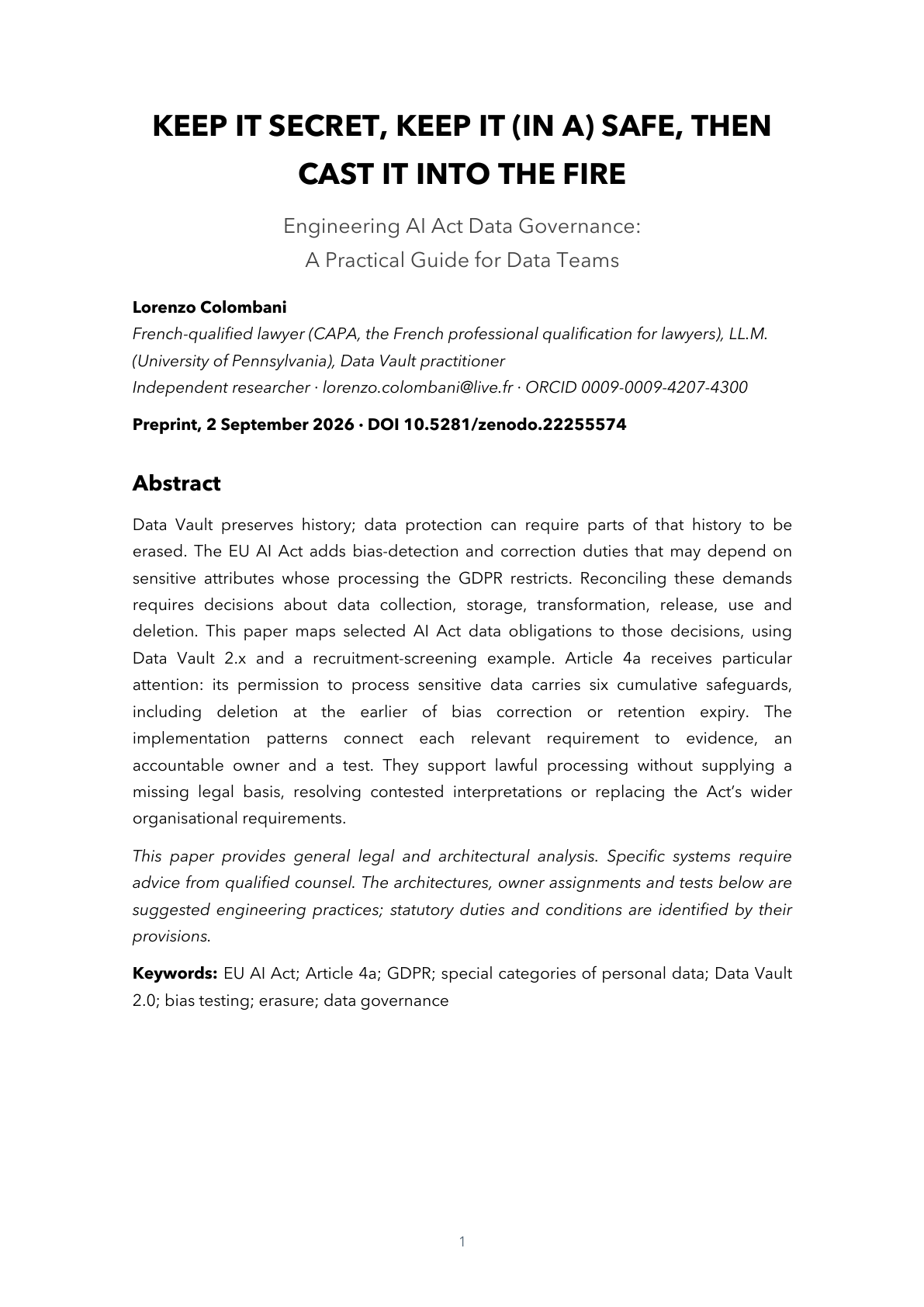
KEEP IT SECRET, KEEP IT (IN A) SAFE, THEN
CAST IT INTO THE FIRE
Engineering AI Act Data Governance:
A Practical Guide for Data Teams
Lorenzo Colombani
French-qualified lawyer (CAPA, the French professional qualification for lawyers), LL.M.
(University of Pennsylvania), Data Vault practitioner
Independent researcher · lorenzo.colombani@live.fr · ORCID 0009-0009-4207-4300
Preprint, 2 September 2026 · DOI 10.5281/zenodo.22255574

Abstract
Data Vault preserves history; data protection can require parts of that history to be
erased. The EU AI Act adds bias-detection and correction duties that may depend on
sensitive attributes whose processing the GDPR restricts. Reconciling these demands
requires decisions about data collection, storage, transformation, release, use and
deletion. This paper maps selected AI Act data obligations to those decisions, using
Data Vault 2.x and a recruitment-screening example. Article 4a receives particular
attention: its permission to process sensitive data carries six cumulative safeguards,
including deletion at the earlier of bias correction or retention expiry. The
implementation patterns connect each relevant requirement to evidence, an
accountable owner and a test. They support lawful processing without supplying a
missing legal basis, resolving contested interpretations or replacing the Act’s wider
organisational requirements.
This paper provides general legal and architectural analysis. Specific systems require
advice from qualified counsel. The architectures, owner assignments and tests below are
suggested engineering practices; statutory duties and conditions are identified by their
provisions.
Keywords: EU AI Act; Article 4a; GDPR; special categories of personal data; Data Vault
2.0; bias testing; erasure; data governance

1
Page 2
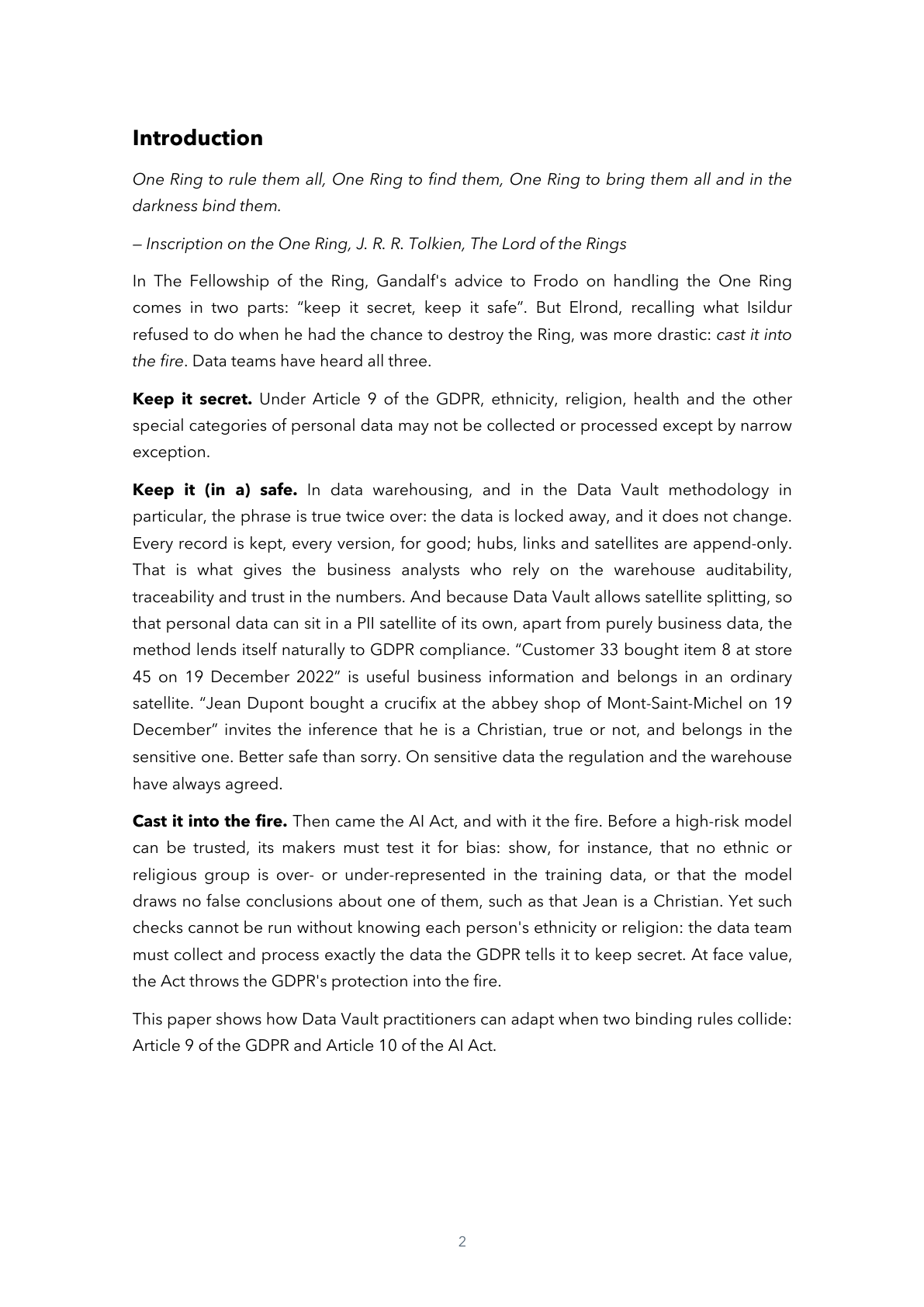
Introduction
One Ring to rule them all, One Ring to find them, One Ring to bring them all and in the
darkness bind them.
— Inscription on the One Ring, J. R. R. Tolkien, The Lord of the Rings
In The Fellowship of the Ring, Gandalf's advice to Frodo on handling the One Ring
comes in two parts: “keep it secret, keep it safe”. But Elrond, recalling what Isildur
refused to do when he had the chance to destroy the Ring, was more drastic: cast it into
the fire. Data teams have heard all three.
Keep it secret. Under Article 9 of the GDPR, ethnicity, religion, health and the other
special categories of personal data may not be collected or processed except by narrow
exception.
Keep it (in a) safe. In data warehousing, and in the Data Vault methodology in
particular, the phrase is true twice over: the data is locked away, and it does not change.
Every record is kept, every version, for good; hubs, links and satellites are append-only.
That is what gives the business analysts who rely on the warehouse auditability,
traceability and trust in the numbers. And because Data Vault allows satellite splitting, so
that personal data can sit in a PII satellite of its own, apart from purely business data, the
method lends itself naturally to GDPR compliance. “Customer 33 bought item 8 at store
45 on 19 December 2022” is useful business information and belongs in an ordinary
satellite. “Jean Dupont bought a crucifix at the abbey shop of Mont-Saint-Michel on 19
December” invites the inference that he is a Christian, true or not, and belongs in the
sensitive one. Better safe than sorry. On sensitive data the regulation and the warehouse
have always agreed.
Cast it into the fire. Then came the AI Act, and with it the fire. Before a high-risk model
can be trusted, its makers must test it for bias: show, for instance, that no ethnic or
religious group is over- or under-represented in the training data, or that the model
draws no false conclusions about one of them, such as that Jean is a Christian. Yet such
checks cannot be run without knowing each person's ethnicity or religion: the data team
must collect and process exactly the data the GDPR tells it to keep secret. At face value,
the Act throws the GDPR's protection into the fire.
This paper shows how Data Vault practitioners can adapt when two binding rules collide:
Article 9 of the GDPR and Article 10 of the AI Act.

2
Page 3
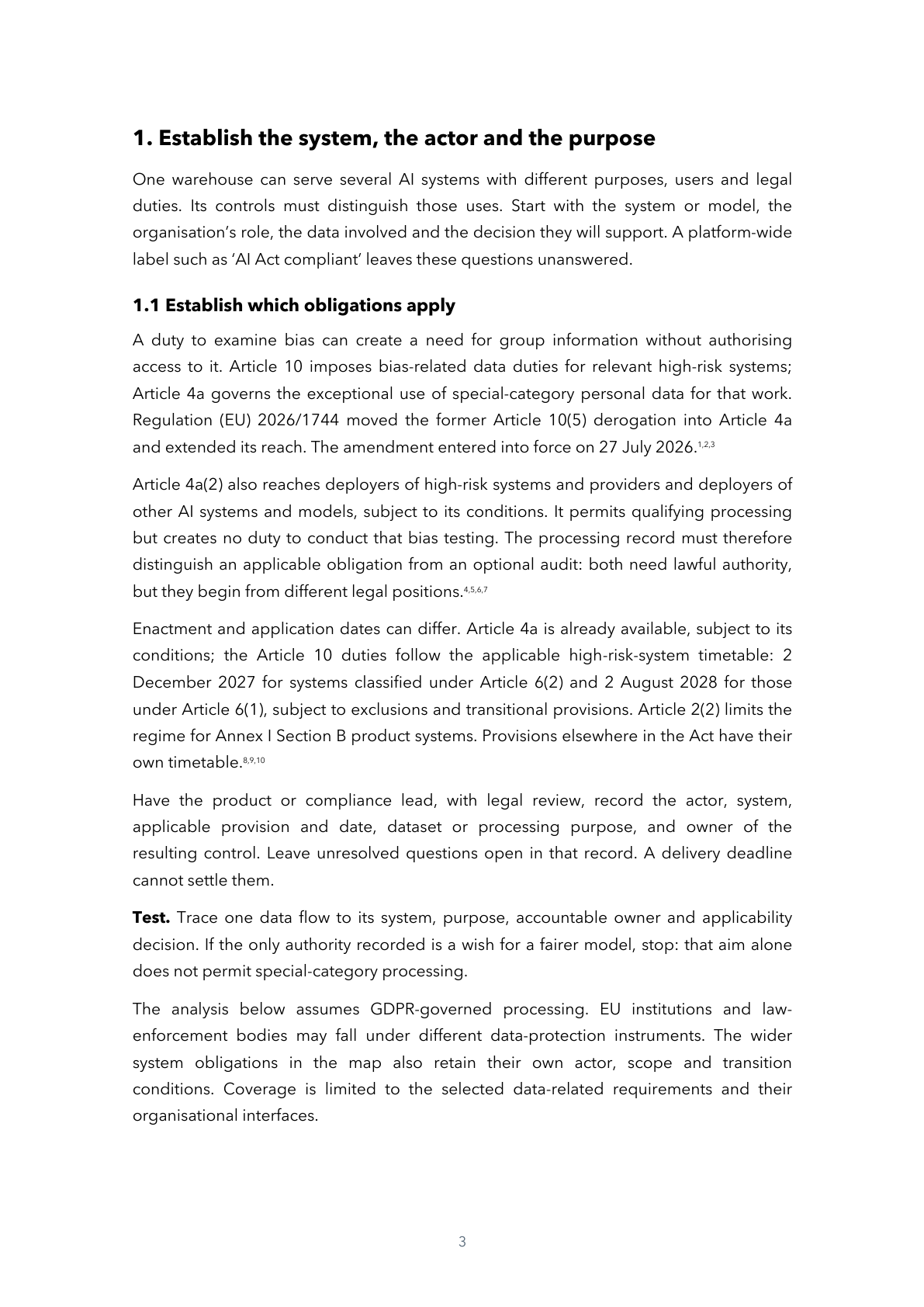
1. Establish the system, the actor and the purpose
One warehouse can serve several AI systems with different purposes, users and legal
duties. Its controls must distinguish those uses. Start with the system or model, the
organisation’s role, the data involved and the decision they will support. A platform-wide
label such as ‘AI Act compliant’ leaves these questions unanswered.

1.1 Establish which obligations apply
A duty to examine bias can create a need for group information without authorising
access to it. Article 10 imposes bias-related data duties for relevant high-risk systems;
Article 4a governs the exceptional use of special-category personal data for that work.
Regulation (EU) 2026/1744 moved the former Article 10(5) derogation into Article 4a
and extended its reach. The amendment entered into force on 27 July 2026.1,2,3
Article 4a(2) also reaches deployers of high-risk systems and providers and deployers of
other AI systems and models, subject to its conditions. It permits qualifying processing
but creates no duty to conduct that bias testing. The processing record must therefore
distinguish an applicable obligation from an optional audit: both need lawful authority,
but they begin from different legal positions.4,5,6,7
Enactment and application dates can differ. Article 4a is already available, subject to its
conditions; the Article 10 duties follow the applicable high-risk-system timetable: 2
December 2027 for systems classified under Article 6(2) and 2 August 2028 for those
under Article 6(1), subject to exclusions and transitional provisions. Article 2(2) limits the
regime for Annex I Section B product systems. Provisions elsewhere in the Act have their
own timetable.8,9,10
Have the product or compliance lead, with legal review, record the actor, system,
applicable provision and date, dataset or processing purpose, and owner of the
resulting control. Leave unresolved questions open in that record. A delivery deadline
cannot settle them.
Test. Trace one data flow to its system, purpose, accountable owner and applicability
decision. If the only authority recorded is a wish for a fairer model, stop: that aim alone
does not permit special-category processing.
The analysis below assumes GDPR-governed processing. EU institutions and lawenforcement bodies may fall under different data-protection instruments. The wider
system obligations in the map also retain their own actor, scope and transition
conditions. Coverage is limited to the selected data-related requirements and their
organisational interfaces.

3
Page 4
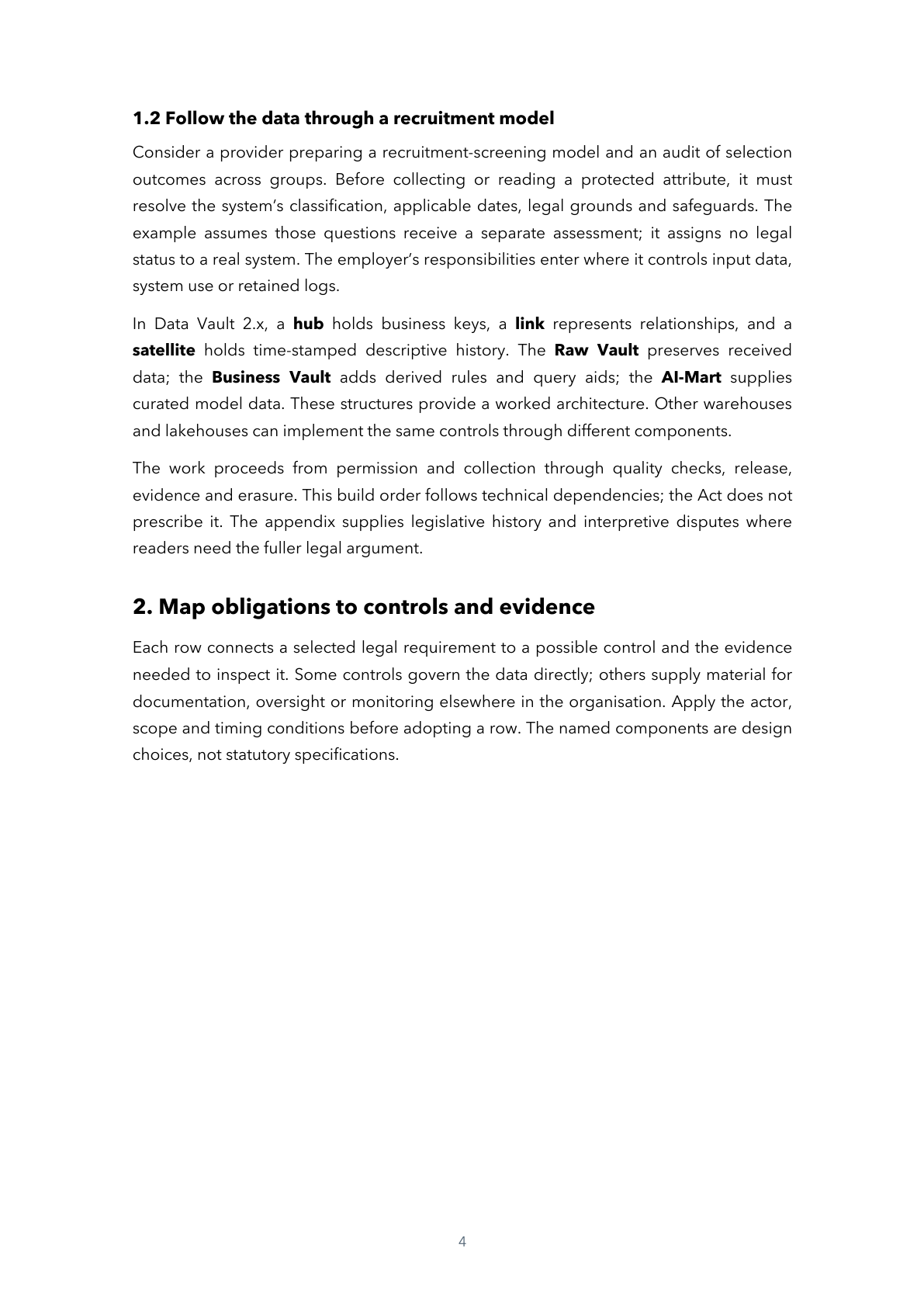
1.2 Follow the data through a recruitment model
Consider a provider preparing a recruitment-screening model and an audit of selection
outcomes across groups. Before collecting or reading a protected attribute, it must
resolve the system’s classification, applicable dates, legal grounds and safeguards. The
example assumes those questions receive a separate assessment; it assigns no legal
status to a real system. The employer’s responsibilities enter where it controls input data,
system use or retained logs.
In Data Vault 2.x, a hub holds business keys, a link represents relationships, and a
satellite holds time-stamped descriptive history. The Raw Vault preserves received
data; the Business Vault adds derived rules and query aids; the AI-Mart supplies
curated model data. These structures provide a worked architecture. Other warehouses
and lakehouses can implement the same controls through different components.
The work proceeds from permission and collection through quality checks, release,
evidence and erasure. This build order follows technical dependencies; the Act does not
prescribe it. The appendix supplies legislative history and interpretive disputes where
readers need the fuller legal argument.

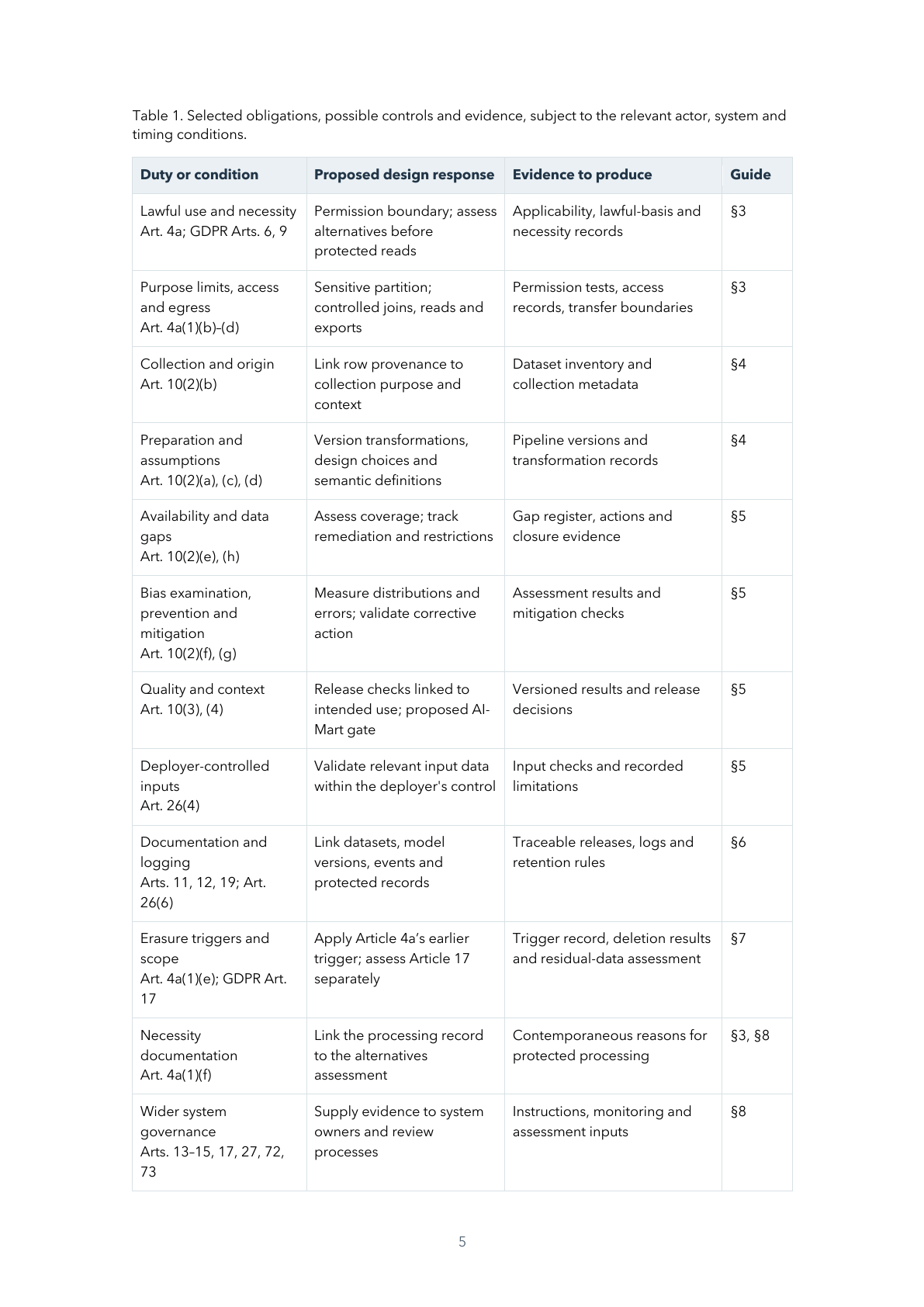
2. Map obligations to controls and evidence
Each row connects a selected legal requirement to a possible control and the evidence
needed to inspect it. Some controls govern the data directly; others supply material for
documentation, oversight or monitoring elsewhere in the organisation. Apply the actor,
scope and timing conditions before adopting a row. The named components are design
choices, not statutory specifications.

4
Page 5
Table 1. Selected obligations, possible controls and evidence, subject to the relevant actor, system and
timing conditions.
Duty or condition

Proposed design response

Evidence to produce

Guide

Lawful use and necessity
Art. 4a; GDPR Arts. 6, 9

Permission boundary; assess
alternatives before
protected reads

Applicability, lawful-basis and
necessity records

§3

Purpose limits, access
and egress
Art. 4a(1)(b)–(d)

Sensitive partition;
controlled joins, reads and
exports

Permission tests, access
records, transfer boundaries

§3

Collection and origin
Art. 10(2)(b)

Link row provenance to
collection purpose and
context

Dataset inventory and
collection metadata

§4

Preparation and
assumptions
Art. 10(2)(a), (c), (d)

Version transformations,
design choices and
semantic definitions

Pipeline versions and
transformation records

§4

Availability and data
gaps
Art. 10(2)(e), (h)

Assess coverage; track
remediation and restrictions

Gap register, actions and
closure evidence

§5

Bias examination,
prevention and
mitigation
Art. 10(2)(f), (g)

Measure distributions and
errors; validate corrective
action

Assessment results and
mitigation checks

§5

Quality and context
Art. 10(3), (4)

Release checks linked to
intended use; proposed AIMart gate

Versioned results and release
decisions

§5

Deployer-controlled
inputs
Art. 26(4)

Validate relevant input data
within the deployer's control

Input checks and recorded
limitations

§5

Documentation and
logging
Arts. 11, 12, 19; Art.
26(6)

Link datasets, model
versions, events and
protected records

Traceable releases, logs and
retention rules

§6

Erasure triggers and
scope
Art. 4a(1)(e); GDPR Art.
17

Apply Article 4a’s earlier
trigger; assess Article 17
separately

Trigger record, deletion results
and residual-data assessment

§7

Necessity
documentation
Art. 4a(1)(f)

Link the processing record
to the alternatives
assessment

Contemporaneous reasons for
protected processing

§3, §8

Wider system
governance
Arts. 13–15, 17, 27, 72,
73

Supply evidence to system
owners and review
processes

Instructions, monitoring and
assessment inputs

§8

5
Page 6
Article 10 reaches well beyond the bias measurement itself. It covers design choices,
collection, preparation, assumptions, data availability and suitability, mitigation, and
gaps and their treatment. For high-risk systems not developed using model-training
techniques, Article 10(6) applies the specified data requirements to testing datasets.
Record the dataset type so the correct requirements follow it.11
The provider’s training dataset and the employer’s live applicant records sit under
different responsibilities. Article 26(4) requires deployers to ensure relevant and
sufficiently representative inputs insofar as they control those data. The employer
therefore needs input checks within its control; the provider remains responsible for its
own Article 10 duties.12

2.1 Place the controls in the architecture
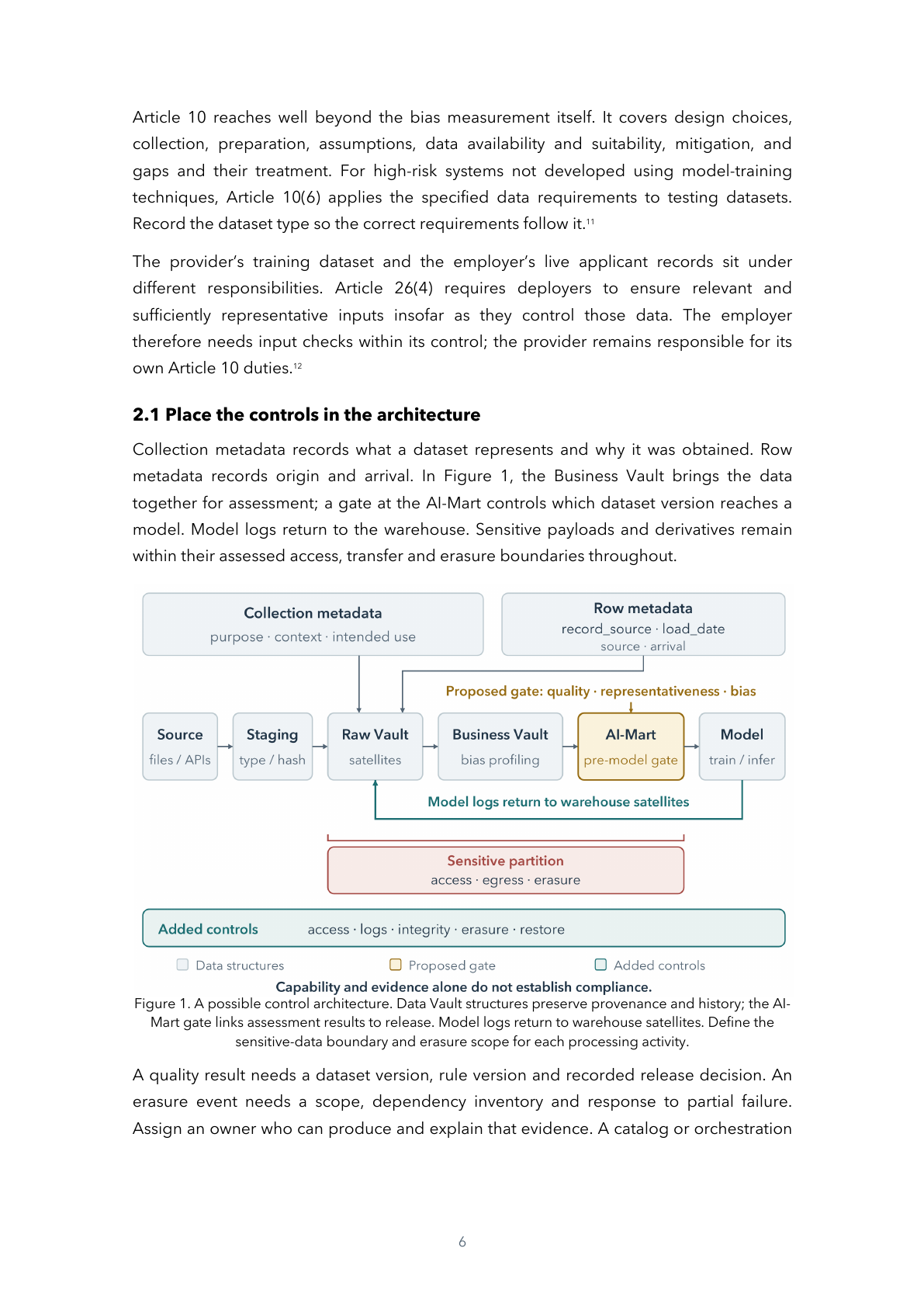
Collection metadata records what a dataset represents and why it was obtained. Row
metadata records origin and arrival. In Figure 1, the Business Vault brings the data
together for assessment; a gate at the AI-Mart controls which dataset version reaches a
model. Model logs return to the warehouse. Sensitive payloads and derivatives remain
within their assessed access, transfer and erasure boundaries throughout.

Figure 1. A possible control architecture. Data Vault structures preserve provenance and history; the AIMart gate links assessment results to release. Model logs return to warehouse satellites. Define the
sensitive-data boundary and erasure scope for each processing activity.

A quality result needs a dataset version, rule version and recorded release decision. An
erasure event needs a scope, dependency inventory and response to partial failure.
Assign an owner who can produce and explain that evidence. A catalog or orchestration

6
Page 7
service may hold it; a new hub or satellite is useful only where the modelling need
warrants one.

3. Establish permission and define the sensitive boundary
A recruitment audit comparing selection outcomes may need data revealing ethnicity.
Those data fall within Article 9 GDPR: collecting or using them is processing even if the
report contains only statistics.13 Before choosing tables or running queries, establish the
permitted purpose, records and users. An instruction to “check fairness” leaves those
decisions unresolved.

3.1 Establish the legal basis
Special-category processing needs both an Article 6 lawful basis and an Article 9
exception.14 Article 4a operates alongside the GDPR and does not identify the
organisation’s Article 6 ground.15,16,17 The controller, supported by counsel, should
explain why each route covers the actor and activity. If the necessary grounds or Article
4a conditions cannot be established, sensitive-data processing must not proceed;
technical safeguards cannot cure missing authority.18
Article 6(1)(c) may provide a basis for processing necessary to meet an applicable Article
10 bias-related duty.19 An eligible private-sector controller considering Article 6(1)(f)
must establish that the interest is lawful, that processing is necessary, and that the
individual’s interests or fundamental rights and freedoms do not override it.20 Public
authorities need another applicable Article 6 basis for processing in the performance of
their public tasks.14 Record whether testing fulfils a duty or is voluntary: Article 4a(2) does
not itself create a duty to test.5

3.2 Assess alternatives before reading protected records
Condition (a) requires an evidenced conclusion that other data, including synthetic or
anonymised data, cannot effectively fulfil the objective; condition (f) requires the strictnecessity explanation in the records of processing activities.21,22 Define the intended
comparison and assess already anonymous results, suitable synthetic data and other
separately lawful sources. Record what each can establish and where it falls short. A
controlled comparison may help, but the law prescribes neither one experiment nor an
exhaustive sequence of techniques. Protected records cannot be read for this
assessment before permission and safeguards are established.
Overall selection rates may conceal differences between groups. A postcode proxy may
be unreliable, may itself reveal ethnicity, and may require the protected attribute for
validation.23,24 Computing an anonymous aggregate from identifiable protected records
also remains record-level processing. A third party holding those records relocates the
Article 9 question and may conflict with Article 4a’s restriction on other parties’ access.25,26

7
Page 8
Use sufficient alternatives within their lawful boundary; otherwise document their limits
before authorising sensitive processing.

3.3 Define what may enter the warehouse
Ethnicity can sit in a dedicated sensitive satellite* linked to the audit’s subject records,
with access to identifying information controlled separately. A campaign-specific
partition is another option. Choose boundaries according to permitted use and what
must be erased together. The controller and data engineer should record the purpose,
dataset and model versions, necessary attributes, permitted users, destinations,
retention deadline and deletion unit. Hashing the business key does not make
associated records anonymous when identification remains possible.27
All six Article 4a conditions must be met, with safeguards in place, before processing
begins. Condition (b) requires technical limits on reuse and state-of-the-art security and
privacy-preserving measures, including pseudonymisation; condition (c) requires strict
access controls, confidentiality obligations and access documentation; condition (d)
prohibits transmission, transfer or access by other parties. “Other parties” needs
assessment for the arrangement; it cannot be reduced to “no unauthorised sharing”.28,29,26
The platform owner should test satellite permissions and outbound paths; the data
owner should check fields and joins against the approved purpose. Use actual queries to
establish that the controls hold.
Condition (e) requires deletion at the earlier of bias correction and retention expiry.30
Before the first sensitive load, define the correction event and an erasure path covering
dependent data and recovery processes. The controller owns the permission and
necessity record; engineering owners supply evidence that the controls work.
Test. Using non-personal fixtures, attempt separate loads with a missing permission
reference, an unapproved attribute and an undefined erasure scope. Each should be
refused and recorded. Run a permitted load and confirm that only authorised roles can
query it. Record the configuration and owners; successful fixture tests do not establish
lawful processing.

*

‘Sensitive satellite’ is descriptive, not a term of art. The published practitioner vocabulary (Linstedt;
Scalefree, n 54) is a ‘satellite split’ into a personal-data satellite and a non-personal satellite. ‘PII satellite’
is also common, but ‘PII’ is American vocabulary (NIST) and means all personal data, names and
addresses included. ‘Sensitive’ here is narrower: it means the special categories of Article 9 GDPR only,
such as ethnicity or religion. In EU terms the safest phrasing is ‘special-category satellite’.

8
Page 9
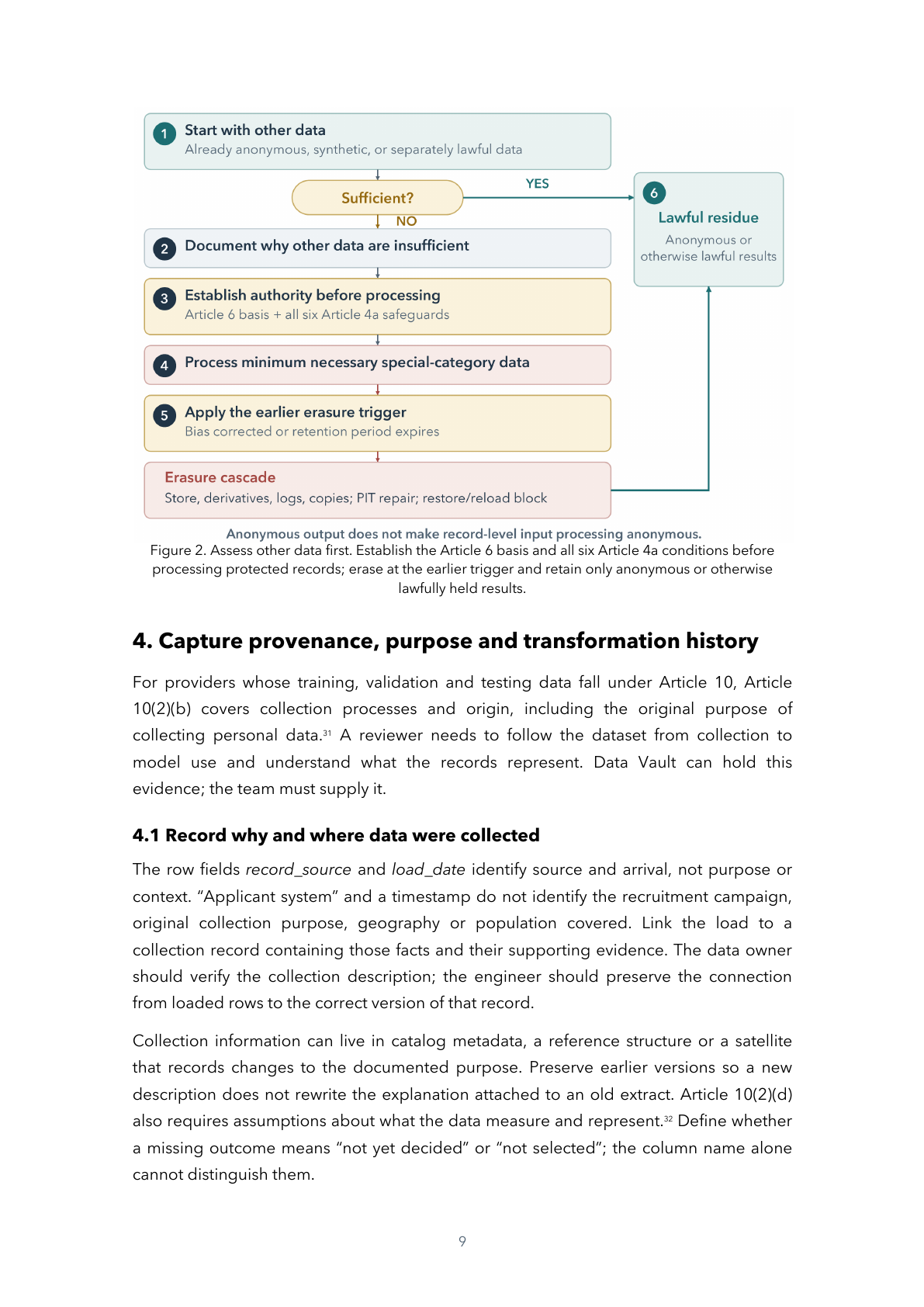
Figure 2. Assess other data first. Establish the Article 6 basis and all six Article 4a conditions before
processing protected records; erase at the earlier trigger and retain only anonymous or otherwise
lawfully held results.

4. Capture provenance, purpose and transformation history
For providers whose training, validation and testing data fall under Article 10, Article
10(2)(b) covers collection processes and origin, including the original purpose of
collecting personal data.31 A reviewer needs to follow the dataset from collection to
model use and understand what the records represent. Data Vault can hold this
evidence; the team must supply it.

4.1 Record why and where data were collected
The row fields record_source and load_date identify source and arrival, not purpose or
context. “Applicant system” and a timestamp do not identify the recruitment campaign,
original collection purpose, geography or population covered. Link the load to a
collection record containing those facts and their supporting evidence. The data owner
should verify the collection description; the engineer should preserve the connection
from loaded rows to the correct version of that record.
Collection information can live in catalog metadata, a reference structure or a satellite
that records changes to the documented purpose. Preserve earlier versions so a new
description does not rewrite the explanation attached to an old extract. Article 10(2)(d)
also requires assumptions about what the data measure and represent.32 Define whether
a missing outcome means “not yet decided” or “not selected”; the column name alone
cannot distinguish them.

9
Page 10
Record relevant design choices alongside source facts.11 Explain why the audit counts
applications rather than people or vacancies, and why the selected outcome represents
the model’s intended task. Link those decisions to the collection and semantic records. A
reproducible query can still measure the wrong thing if its unit of analysis is poorly
chosen or undocumented.

4.2 Trace each transformation
Document how applications were matched to outcomes, duplicates treated and
outcome labels derived. Article 10(2)(c) covers preparation operations including
annotation, labelling, cleaning, updating, enrichment and aggregation.33 The Raw Vault
can preserve received history, the Business Vault hold derived rules, and the mart deliver
model extracts. To trace a result through those layers, the pipeline must record which
rule and execution produced it.
A released extract should point to its source collections, transformation versions,
execution records and semantic definitions. The data engineering owner should
maintain that history through orchestration logs, version-controlled code and catalog
entries. References must identify the versions actually used. For manual changes to
labels or mappings, record the reason and accountable owner.
A transformation log need not copy protected values to prove that a rule ran. Diagnostic
payloads that contain them need access controls and erasure coverage. Preserve the
method, decisions and permitted results, while acknowledging that they cannot support
indefinite recomputation once the underlying protected records have been lawfully
deleted.
Test. Trace a transformed field in a released extract to its collection record and exact
transformation version. Ask a reviewer other than the pipeline author to explain its
purpose, missing-value meaning and derivation. After changing a mapping rule, verify
that the earlier extract still points to the earlier rule and the new extract identifies the
change.

5. Measure data quality and bias, then control release
For providers subject to Article 10, datasets must be relevant, sufficiently representative,
have appropriate statistical properties, and be as complete and error-free as possible.
The Act also requires examination of specified biases and appropriate measures to
detect, prevent and mitigate them.34,6 Set and justify assessment criteria for the intended
use, calculate the evidence and withhold unsuitable extracts. These duties supply no
universal acceptance threshold.

10
Page 11
5.1 Define the population and measures
A correctly loaded dataset may cover the wrong region, period or recruitment process.
The model and data owners should define the intended population, setting and
outcomes. Article 10(4) addresses the geographic, contextual, behavioural and
functional setting of use.35 Checks can cover missing outcomes, duplicate applications,
population coverage and differences in relevant selection or error rates. Record their
tolerances, rationale and treatment of uncertainty. An enforceable percentage is not
automatically a legally sufficient one.
Article 10(2) requires assessment of data availability, quantity and suitability, and
identification of relevant gaps or shortcomings and how to address them.11 Name
missing populations or unreliable labels, explain their effect on intended use and assign
an owner to the response. More rows from the same unsuitable source may not close the
gap. Carry unresolved limitations into the release decision.
Group-level results may reveal a disparity without showing how to correct it.
Reweighting, relabelling or targeted collection can require record-level links between
protected attributes, model inputs and outcomes. Permission for a statistical comparison
does not automatically cover those operations. The model owner should explain what
the measurements establish, what remains uncertain and whether correction needs a
revised processing decision. Record the measures used to detect, prevent and mitigate
identified bias, their owners and the evidence of their effects.11

5.2 Make assessment govern release
The Business Vault can hold integrated data and queries that measure coverage, quality
and bias. An AI-Mart gate can withhold extracts that fail the agreed checks. Practitioner
work describes the AI-Mart as a location for curated, validated training data; the Act
requires no such named layer.36 An export service or training pipeline can enforce the
same decision. The assessment must govern the route that actually supplies data to the
model.
The release record should identify dataset and model versions, assessment results,
unresolved limitations and the decision owner. Engineering supplies execution
evidence; the model owner explains the consequences for intended use. A completed
job cannot substitute for a missing or failed assessment. Where an exception is allowed,
document it and keep it within applicable requirements and the approved scope. An
override cannot make unlawful processing lawful.

5.3 Check deployer-controlled inputs separately
An employer may control the applicant records supplied to the recruitment system while
the provider controls its training dataset. Article 26(4) requires relevant and sufficiently
representative inputs insofar as the deployer controls them.12 The employer’s data owner

11
Page 12
should identify that boundary, apply the provider’s input specifications and assess
whether the records fit the intended recruitment setting. This responsibility is distinct
from the provider’s training-data programme.
For each input batch, record its source, expected fields, quality and coverage checks,
known limitations and accountable reviewer. Test an incomplete or out-of-scope batch
before it reaches the live input route. The process should hold or reject it, record the
reason and escalate to the system owner. Schema checks alone cannot establish
representativeness; deployers should not claim control or evidence over data they
cannot inspect.

5.4 Assess what may be retained
Small groups and overlapping queries can expose membership, hidden attributes or
individual records. Aggregate data are not inherently anonymous.37 Cell suppression,
minimum group sizes and differential-privacy noise may reduce disclosure risk while
weakening the audit’s signal. Configure them for the use case and the GDPR test of
whether identification remains reasonably likely; there is no universal “safe” cell count.27
The responsible owner should record the disclosure assessment and its effect on the
conclusions.
Computed satellites in the Business Vault can retain lawful audit results linked to an audit
run or model version.38 The results still need sufficient anonymity or another lawful basis.
They cannot support every future metric once protected records have been deleted.
Record that limit, the method and the supporting evidence that may remain.
Test. Add a known quality defect to a non-personal test extract. Separately, omit its
assessment result. Verify that both attempts are refused at the model-input route and
produce usable failure records. Test the report’s small-group and overlapping-query
controls, and check that its interpretation accounts for any suppression or noise.

6. Connect datasets, model use and evidence
6.1 Make each delivery traceable
For each released recruitment model, retain a trace to the dataset version, the changes
made to it and the decisions permitting its use.
Hubs hold business identifiers, links represent relationships, and satellites preserve
descriptive history. Normal satellite loads append rows, supporting a historical system of
record and parallel loading; controlled deletion remains technically possible.39,40,41 Give
each dataset release, model version and bias-review campaign a stable identifier.
Connect them through links and attach the relevant decisions, transformations and
results through satellites.

12
Page 13
The data engineering owner should be able to trace a delivery from its source and
collection context through preparation, Business Vault measurements and the AI-Mart
release decision to the receiving model version. Attach the approved purpose and
retention rule to the campaign; record_source and load_date do not convey them.
Record the transformation version and checks that accepted the extract. Keep enough
version information to explain a historical result without retaining protected values
beyond their lawful deletion point.
Test. Ask a reviewer who did not build the pipeline to identify a model version's dataset,
transformation rules, check results and release decision. Change the dataset version or
fail a release check: the trace should distinguish the new attempt, and the failed extract
should not reach the model. These tests do not establish that the metrics or thresholds
satisfy the law.

6.2 Control model logs
Where Article 12 applies, high-risk systems must support automatic event logging
throughout their lifetime.42 Paragraphs 1 and 2 contain the general requirements;
paragraph 3's detailed list applies to specified biometric systems.43 Choose fields for the
applicable requirements. Lifetime logging capability does not require lifetime retention
of every event: assess retention separately.
Training and inference logs can return to the warehouse as satellites linked to the run or
model version, following published Data Vault practice.44 Select useful evidence—
potentially inputs, transformations, parameters, outputs and confidence scores—without
copying every input into a permanent log. Model and platform owners should agree on
event meanings, access restrictions and retention. Omit sensitive values where the
logging purpose can be met without them; otherwise include those log satellites in the
sensitive perimeter and erasure plan.
A source-system audit trail does not establish who queried the warehouse. Status
tracking satellites can preserve source-supplied create, read, update and delete events;
warehouse query and access logs describe a different boundary. Verify that the chosen
evidence identifies the relevant user, operation and data scope without unnecessarily
copying protected values.45
A privileged operator may change history despite append-only loading. Protect change
and access logs, restrict mutation rights and provide appropriate integrity checks.
Record authorised erasure without preserving the deleted payload. Test both a
forbidden mutation and an authorised erasure: the former should be blocked or
detected, while the latter should leave the remaining evidence usable.
Article 19(1) assigns retention of provider-controlled logs to the provider; Article 26(6)
addresses the deployer. Each requires a period appropriate to the purpose of at least six

13
Page 14
months, unless applicable law, particularly data-protection law, provides otherwise.46
Identify which model-operation logs the recruitment-model provider controls and which
use logs the employer controls. Distinguish ordinary operational evidence from
protected payloads subject to the assessed erasure scope.

6.3 Retain evidence lawfully
A computed satellite may retain a lawful result, its method, campaign identifier and
decision record after deletion.38 Small groups or overlapping results may still expose
individuals: aggregation alone does not establish anonymity.37,27 Record the anonymity
assessment or other lawful basis for retention, and the resulting limits on re-audit. A
saved recruitment-disparity result cannot recreate deleted records for every later metric
or model version.

7. Make retention and erasure executable
7.1 Connect both deletion triggers
Article 4a(1)(e) requires deletion at the earlier of bias correction and retention expiry.47 A
scheduler can detect a deadline, but cannot decide that bias has been corrected. The
model owner and legal or governance function must define, validate and record that
state. Engineering then connects the lifecycle event and retention deadline to one
erasure workflow. Van Bekkum notes the condition's close relationship to GDPR storage
limitation: the retention decision needs justification as well as an executable deadline.48
Before loading, define whether deletion covers a campaign, model version, subject or
narrower set with a common purpose and trigger. Map that scope to satellite rows,
features, intermediate tables, marts, logs, exports and recoverable copies. Assign an
operational owner to complete deletion across that inventory and escalate failures.
Record the scope, trigger, affected components and outcome without copying the
protected value.

7.2 Match the pattern to the deletion unit
A table, a row set and an encryption key define different deletion boundaries. Match the
pattern to the approved scope and recovery behaviour.

14
Page 15
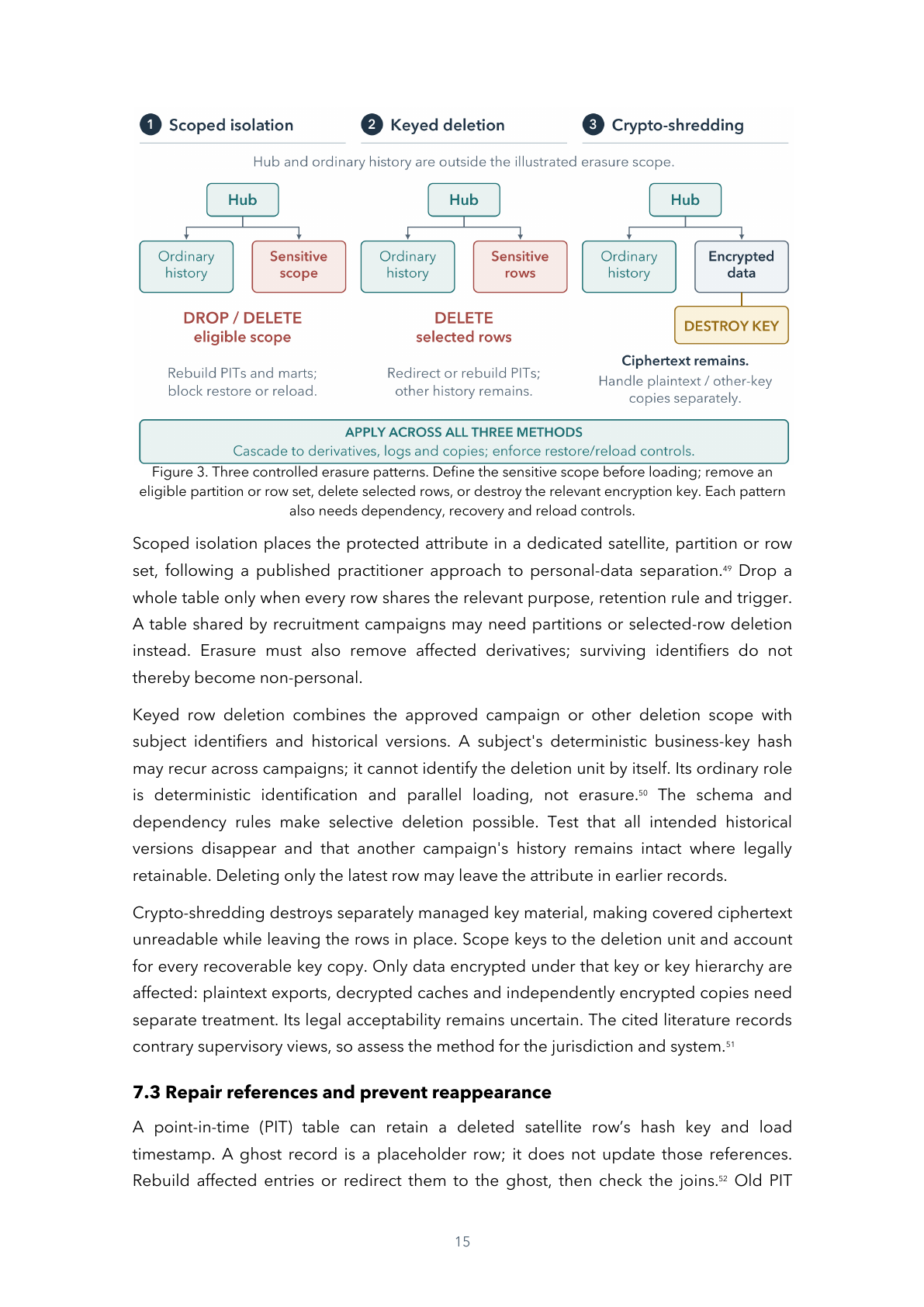
Figure 3. Three controlled erasure patterns. Define the sensitive scope before loading; remove an
eligible partition or row set, delete selected rows, or destroy the relevant encryption key. Each pattern
also needs dependency, recovery and reload controls.

Scoped isolation places the protected attribute in a dedicated satellite, partition or row
set, following a published practitioner approach to personal-data separation.49 Drop a
whole table only when every row shares the relevant purpose, retention rule and trigger.
A table shared by recruitment campaigns may need partitions or selected-row deletion
instead. Erasure must also remove affected derivatives; surviving identifiers do not
thereby become non-personal.
Keyed row deletion combines the approved campaign or other deletion scope with
subject identifiers and historical versions. A subject's deterministic business-key hash
may recur across campaigns; it cannot identify the deletion unit by itself. Its ordinary role
is deterministic identification and parallel loading, not erasure.50 The schema and
dependency rules make selective deletion possible. Test that all intended historical
versions disappear and that another campaign's history remains intact where legally
retainable. Deleting only the latest row may leave the attribute in earlier records.
Crypto-shredding destroys separately managed key material, making covered ciphertext
unreadable while leaving the rows in place. Scope keys to the deletion unit and account
for every recoverable key copy. Only data encrypted under that key or key hierarchy are
affected: plaintext exports, decrypted caches and independently encrypted copies need
separate treatment. Its legal acceptability remains uncertain. The cited literature records
contrary supervisory views, so assess the method for the jurisdiction and system.51

7.3 Repair references and prevent reappearance
A point-in-time (PIT) table can retain a deleted satellite row’s hash key and load
timestamp. A ghost record is a placeholder row; it does not update those references.
Rebuild affected entries or redirect them to the ghost, then check the joins.52 Old PIT
15
Page 16
snapshots can ordinarily be reconstructed from the Raw Vault.53 Erasure must prevent
reconstruction of the protected value, not just remove a query structure.
A restore, retry or source refresh must not make an erased value available again. Apply
the assessed scope to backups and other recoverable copies. A suppression record can
coordinate this only if its content and use are appropriate; do not retain the deleted
attribute inside the deletion log. Have the recovery owner demonstrate the restoration
procedure before the campaign enters production.
A completed campaign deletion may leave an Article 17 GDPR request unresolved. That
right has its own grounds and exceptions and may reach hub identifiers, business keys,
links or other satellites left intact by Article 4a's attribute-focused deletion.54 The
literature on resistant storage likewise treats erasure as a wider architectural problem.55
Assess the broader request against an inventory of personal data; an empty bias satellite
is not a completion criterion.

7.4 Resolve log retention and model effects
Article 26(6) requires deployers to retain automatically generated logs under their
control for a purpose-appropriate period of at least six months, unless applicable law,
particularly data-protection law, provides otherwise.56 Campaign closure does not
authorise discarding all operational logs. Assess which special-category values fall within
Article 4a's earlier trigger and which other records can or must remain. Encode those
scopes separately.
Deleting training data does not automatically remove its effect on the model.
Reweighting, relabelling or sampling may use a protected attribute absent from the final
inputs. Full retraining is the reference point for comparison; exact and approximate
unlearning differ in cost, access requirements and limits.57 Record the attribute's
influence and assess the need for retraining, unlearning, replacement or another
documented response. Whether the model retains or exposes personal data requires a
case-specific assessment of extraction and query risks.58 A warehouse deletion test
cannot answer that question.

8. Test, operate and hand over the controls
8.1 Test the whole path, including failure
With suitable test data, run a campaign through permitted collection, profiling, release,
logging and deletion. Trigger bias correction before the retention deadline, then reverse
the order in a separate run. Verify the primary and derived stores, PIT repair, logging
treatment and lawful retained results. Inspect the data and query behaviour, not just the
job status.

16
Page 17
Interrupt a deletion and retry it. Restore an older copy under the documented procedure
and replay a source load; neither should reintroduce the protected value into use.
Attempt an unauthorised read or export with an ordinary account: both must be denied.
Test privileged modification under agreed controls, specifying whether prevention or
detection is achievable and how to escalate and remedy tampering. Detecting a
completed unauthorised disclosure does not pass an access-control test. Record failures
and responsible owners.

8.2 Hand over decisions, evidence and responsibility
The handover should cover applicability and lawful processing; dataset and model
relationships; sensitive scope; release checks; access and egress rules; log fields and
retention; deletion triggers and method; recovery and reload; test results; and
unresolved issues. Name an accountable function for each operational responsibility.
Operations need a runbook for recognising triggers, inspecting progress, recovering
from partial failure, checking remaining data and escalating unresolved components.
The model owner needs the separate decision on model effects and re-audit limits. Give
governance the test results, failures and judgments still open. Review the records when
sources, model use, transformations, retention rules or recovery arrangements change.

8.3 Support wider system obligations
Send the provider's documentation owner the dataset versions, collection context,
transformation history, validation results and known limitations needed for the technical
file. Connect runbooks and review records to the quality-management system. Articles
11, 16 and 17 require more documentation and procedures than a catalog can supply;
Article 18's ten-year rule covers the listed documentation, not blanket retention of
personal training data.46
Supply input specifications and performance limitations to the team writing deployer
instructions. Give human-oversight owners intelligible evidence and intervention paths;
an automated release gate is not human oversight. Work with model, platform and
security teams on accuracy, robustness, feedback and poisoning risks. These
contributions support Articles 13–15; a warehouse quality score cannot establish
compliance with them.59
After release, link monitoring results and reported problems to the affected model,
dataset and processing versions. Send significant signals to the monitoring or incident
owner with timestamps and usable evidence. A threshold breach is not automatically a
reportable serious incident; an unreviewed pipeline should not make that determination.
For deployers within Article 27's defined cohort, subject to its exceptions, supply the
data-flow, population and safeguard facts for the fundamental-rights impact assessment.

17
Page 18
Assess the applicability and timing of Articles 72–73 separately, including their
transitions.60
Test. Select a monitoring alert and check that an accountable person can identify the
system and dataset version, retrieve the evidence and follow the review and escalation
route. Confirm that the instructions and technical file describe the same released
configuration. Passing this test does not determine whether an incident is legally
reportable.

8.4 Keep the limits visible
Review the affected controls when permissions, pipelines, models or recovery
procedures change. Verify that the safeguards still work where the data are processed.
Successful tests establish neither strict necessity nor an Article 6 basis.18 Article 4a(2)
does not create a general duty to conduct bias testing outside the applicable
obligations.61 Record the assessed high-risk scope, application dates, exclusions and
distinct general-purpose-model regime in the handover.10 Quality management,
conformity assessment, technical documentation and organisational accountability
extend beyond the warehouse and require continuing operation.

9. Conclusion
The warehouse’s capacity to remember is valuable precisely where deletion hurts:
reconstructing a decision, checking a new source of bias, or explaining an earlier result.
GDPR’s restrictions and erasure duties still apply, alongside the AI Act’s applicable
demands. Controlled deletion is possible, but its scope determines which evidence
survives and which questions can no longer be answered. Those choices belong in the
design, with an owner and a lawful purpose for what remains.
Choose the deletion unit before loading. Connect the earlier of the two Article 4a
triggers to a workflow that reaches derivatives, logs and recoverable copies. Test
whether a restore or fresh source load brings the value back. Preserve the method,
decisions and results that may lawfully remain, and say what they can no longer prove. A
useful Vault must be able to explain its history—and carry out a justified decision to erase
part of it.

Appendix. Legal background and interpretive limits
A.1 From Article 10(5) to Article 4a
The original exception arrived without a clear account of its origin. Arnoud Engelfriet
traces Article 10(5) to a Commission proposal whose accompanying materials left that
question unanswered. The EDPB and EDPS challenged its interaction with the GDPR in

18
Page 19
2021. Parliament subsequently added safeguards and the exceptional character of the
permission; the Council added the Article 9(2)(g) reference reflected in recital 70 of the
2024 AI Act.62,63
Regulation 2026/1744 deleted Article 10(5) and inserted Article 4a, retaining the six
safeguards while widening the categories of actors able to invoke the permission. The
amended Article 10 cross-references point to Article 4a(1). Article 2(7) continues to
preserve the GDPR subject to the specified AI Act adjustments, and recital 9 links bias
detection and correction to substantial public interest and GDPR Article 9(2)(g). The
architecture must operate within that legal framework.64,65,66

A.2 Article 6 requires a separate basis
Regulation 2026/1744 supplies no general Article 6 ground for bias processing. Its
GDPR references include Article 9(2)(g) in recital 9 and Article 35 in the amended
impact-assessment provision; Article 4a operates in addition to the GDPR. The earlier
regulatory-sandbox recital, by comparison, expressly mentions both Article 6(4) and
Article 9(2)(g). These differences support a separate assessment of the Article 6 ground
and Article 9 route, rather than deriving both from Article 4a.16,17,67
Engelfriet reads the original exception as a tightly bounded, dependent derogation
whose exceptional character points to serious systemic bias. That is his interpretation,
not an express statutory threshold. Article 4a(2)’s broader wording also matters. Where
the grounds or safeguards cannot be established, the available choices are another
lawful technique, a narrower activity, or no processing.68,18

A.3 Distinguish enacted law from the GDPR proposal
The separate GDPR Digital Omnibus proposed a route for special-category data
encountered incidentally during AI development and operation, together with an AIspecific legitimate-interest provision. Unlike the enacted AI Omnibus, it remains a
proposal. Its provisions cannot authorise present processing.69
The EDPB and EDPS considered a dedicated AI legitimate-interest provision
unnecessary: the existing framework already operates case by case. They also requested
clearer interaction among the proposed sensitive-data routes. Council document ST
10729/26, dated 22 June 2026, records the compromise then under discussion. Keep
permission records versioned as the law changes; a possible future permission has no
place in the current processing configuration.70

A.4 Put safeguards where processing occurs
A safeguard written in a policy may fail where the data are actually processed. Engelfriet
connects structural protection to the Court of Justice’s reasoning in La Quadrature du
Net, a judgment arising in a different retention context. The connection supports an

19
Page 20
attributed architectural argument; the Court did not prescribe Data Vault, a partition or
an AI-Mart.71,72,73
A duty to mitigate bias can coexist with restrictions on the data needed to investigate it.
Article 4a(2)’s optional testing remains optional, and duties on providers of high-risk
systems cannot be extended to general-purpose models by analogy. Operating controls
therefore depend on the assessed actor, system and purpose throughout their use.74,61,10

Notes
1.

4.

Regulation (EU) 2026/1744 of the European Parliament and of the Council of 8 July 2026
amending Regulations (EU) 2024/1689, (EU) 2018/1139 and (EU) 2023/1230 as regards the
simplification of the implementation of harmonised rules on artificial intelligence (Digital
Omnibus on AI), OJ L, 24 July 2026 (ELI: data.europa.eu/eli/reg/2026/1744/oj); in force on the
third day following publication (Art. 4).
Reg. 2026/1744, Art. 1(9)(b) ("paragraph 5 is deleted").
Reg. 2026/1744, Art. 1(6), inserting Art. 4a into Regulation (EU) 2024/1689. Article citations to the
AI Act herein are to the consolidated text 02024R1689 — EN — 27.07.2026 — 001.001, except
recitals, which are cited to the respective OJ texts.
AI Act, Art. 4a(2).

5.
6.
7.

AI Act, Art. 4a(2), closing sentence.
AI Act, Art. 10(2)(f) and (g).
AI Act, Art. 10(3).

8.

Reg. 2026/1744, recital 9 (final sentence: the legal basis "should apply from the date of entry into
application of that Regulation"); AI Act, Art. 113 (Chapters I and II apply from 2 February 2025;
the amended point (a) carves out the new Art. 5 prohibitions, which apply from 2 December 2026
— immaterial to Art. 4a).

9.

AI Act, Art. 113(c), as amended by Reg. 2026/1744, Art. 1(40) (2 December 2027 for systems
under Art. 6(2); 2 August 2028 for systems under Art. 6(1)); AI Act, Art. 2(2) (for systems related to
products listed in Annex I Section B, only Art. 6(1), Art. 60a, and Arts. 102-112 apply, so Art. 10
does not).

10.

AI Act, Art. 113(c), Arts. 51-56, and Chapter V; Art. 2(2) (limiting the application of Chapter III
duties to systems related to products listed in Annex I Section B).

11.

AI Act, Art. 10(1), (2)(a)–(h) and (6), as amended by Regulation (EU) 2026/1744, Art. 1(9).
Paragraph 6 limits the specified requirements to testing datasets for the development of high-risk
systems not using model-training techniques. Consolidated text: https://eur-lex.europa.eu/legalcontent/EN/TXT/?uri=CELEX:02024R1689-20260727.
AI Act, Art. 26(1), (4): use according to instructions; relevant and sufficiently representative inputs,
in view of intended purpose, insofar as the deployer controls them.

2.
3.

12.
13.

Regulation (EU) 2016/679 (GDPR), OJ L 119, 4 May 2016, Art. 9(1).

14.

GDPR, Arts. 6(1), 6(3), 9(1)–(2), 17(1)–(3). Article 6(1)(f) excludes public-authority processing in
performance of public tasks; points (c)/(e) require the Article 6(3) legal basis. Case C-667/21
Krankenversicherung Nordrhein EU:C:2023:1022, paras 73–79: concurrent Articles 5, 6 and 9
requirements. https://eur-lex.europa.eu/eli/reg/2016/679/oj/eng.

15.

Engelfriet (n 62) 3–5; Case C-667/21 Krankenversicherung Nordrhein EU:C:2023:1022, paras 73–
78, esp. 78, and operative part, point 3 (processing under Art. 9(2)(h) "must, in order to be lawful,
not only comply with the requirements arising from that provision, but must also satisfy at least
one of the conditions of lawfulness set out in Article 6(1)"). The article expressly "does not attempt
to resolve which legal basis under Article 6 GDPR might apply to bias mitigation activities": ibid 2.
Reg. 2026/1744, passim; the only provision-level GDPR citations are recital 9 (Art. 9(2)(g)) and Art.
1(13) (amending AI Act Art. 27(4), citing GDPR Art. 35).

16.

20
Page 21
17.
18.

AI Act, Art. 4a(1), chapeau.
Engelfriet (n 62) 2, 4 (an Article 6 ground assumed to exist elsewhere; the question expressly left
unresolved) and 10 (the fallback where the conditions are unmet: less effective techniques or the
risk of non-compliance).

19.

Van Bekkum (n 24), §4.6.2 (Article 6(1)(c) GDPR juncto Article 10(2) AI Act as "a concrete legal
obligation").
Case C-621/22 Koninklijke Nederlandse Lawn Tennisbond EU:C:2024:858, paras 36–57 (the three
cumulative conditions at para 37; commercial interest at paras 47–49) and operative part (a purely
commercial interest may qualify as a legitimate interest provided it is lawful, the processing is
strictly necessary for it, and the data subject's interests do not override it).
AI Act, Art. 4a(1)(a).

20.

21.
22.
23.

24.

25.

AI Act, Art. 4a(1)(f).
Žliobaitė & Custers, 'Using sensitive personal data may be necessary for avoiding discrimination
in data-driven decision models' (2016) 24 Artificial Intelligence and Law 183; Veale & Binns,
'Fairer machine learning in the real world: Mitigating discrimination without collecting sensitive
data' (2017) 4(2) Big Data & Society, art 2053951717743530.
On the necessity of the protected attribute for proxy validation, see M. van Bekkum, 'Using
sensitive data to de-bias AI systems: Article 10(5) of the EU AI Act' (2025) 56 Computer Law &
Security Review 106115, §2 (a provider "must collect ethnicity data" to establish that an attribute
is a proxy).
Veale & Binns (n 23), proposing trusted third parties that hold sensitive attributes and return
fairness statistics.

26.
27.

AI Act, Art. 4a(1)(d).
GDPR, recital 26 (identifiability assessed by "all the means reasonably likely to be used";
pseudonymised data remains personal data). On the personal/non-personal boundary see M.
Finck & F. Pallas, 'They who must not be identified — distinguishing personal from non-personal
data under the GDPR' (2020) 10(1) International Data Privacy Law 11, 12–13 ("perfect
anonymization is impossible" and the legal definition "needs to embrace the remaining risk"; the
recital 26 reasonable-likelihood test as the operative boundary).

28.
29.

AI Act, Art. 4a(1)(b).
AI Act, Art. 4a(1)(c).

30.
31.
32.
33.

AI Act, Art. 4a(1)(e).
AI Act, Art. 10(2)(b).
AI Act, Art. 10(2)(d).
AI Act, Art. 10(2)(c).

34.
35.

AI Act, Art. 10(3).
AI Act, Art. 10(4).

36.

Scalefree International GmbH, 'AI Act Insight: Ensuring Responsible AI for Your Business'
(scalefree.com/blog/artificial-intelligence/ai-act-insight-ensuring-responsible-ai-for-yourbusiness/, published 29 October 2024, last updated 21 May 2026; accessed 2 September 2026):
the AI-Mart as "a specialized data mart" for curated, validated AI training data, with model logs
loaded back into the warehouse.
A. Gadotti, L. Rocher, F. Houssiau, A.-M. Creţu & Y.-A. de Montjoye, 'Anonymization: The
imperfect science of using data while preserving privacy' (2024) 10(29) Science Advances
eadn7053 (taxonomy of attacks on aggregate data: membership inference, attribute inference,
and reconstruction, with the differencing attack described as "a very simple kind of inference
attack"; aggregate data "do not inherently protect against privacy attacks").

37.

38.

Linstedt & Olschimke (n 41) ch 5.3.6 (computed satellites in the Business Vault).

39.

D. Krneta, V. Jovanović & Z. Marjanović, 'A direct approach to physical Data Vault design' (2014)
11(2) Computer Science and Information Systems 569, 569–570.
A. Vines & R.-E. Samoila, 'An Overview of Data Vault Methodology and Its Benefits' (2023) 27(2)
Informatica Economica 15, 17–21 (hash keys enabling parallel processing of hubs and satellites;
record source and load date mechanics); Linstedt & Olschimke (n 41) chs 4.3–4.5.

40.

21
Page 22
41.

D. Linstedt & M. Olschimke, Building a Scalable Data Warehouse with Data Vault 2.0 (Morgan
Kaufmann 2016) ch 4.5.1 ("Because the history of the data needs to be preserved, you are not
allowed to update or modify the data in the satellite. The only exception to this rule is the Load
End Date attribute") and ch 6 (PIT and bridge tables as Business Vault query-assistant entities).

42.
43.

AI Act, Art. 12(1).
AI Act, Art. 12(2)–(3); the detailed list in Art. 12(3) applies to systems referred to in Annex III, point
1(a).

44.
45.

Scalefree (n 36).
Linstedt & Olschimke (n 41) ch 5.3.3 (status tracking satellites loading CRUD audit trails; logging
of reads "for security reasons to provide information about who accessed which data").
AI Act, Art. 11 and Annex IV; Arts. 16–17; Art. 18(1) (listed documentation until ten years after
placement on the market or putting into service); Arts. 19(1), 26(6) (automatic logs under the
actor's control, retained for a purpose-appropriate period of at least six months unless applicable
law, particularly data-protection law, provides otherwise). Documentation retention does not
itself authorise retention of personal training data.
AI Act, Art. 4a(1)(e) (formerly Art. 10(5)(e)).
Van Bekkum (n 24), §4.6.1.

46.

47.
48.
49.
50.

Scalefree (n 54).
Linstedt & Olschimke (n 41) ch 4.3.2.1: the hash key "replaces the sequence number from the
Data Vault 1.0 standard", is computed from the business key, "can be regenerated", and is crossplatform; that is, no central sequencer is needed and loads parallelize deterministically.

51.

Belen-Saglam et al. (n 55) §4.6.1 ('Hashing out') and accompanying text (encryption-based key
deletion as a proposed right-to-be-forgotten implementation, with contrary views recorded). The
technical effect extends only to data that remain encrypted under the destroyed key material;
plaintext or independently encrypted copies require separate treatment. Politou, Alepis &
Patsakis (n 55) address erasure in resistant infrastructures.
Linstedt & Olschimke (n 41) ch 6.1.1 (PIT entries use a satellite hash key and load timestamp;
ghost records replace missing references so equi-joins remain possible). After a referenced real
row is erased, affected PIT entries must be rebuilt or redirected to the ghost record; the ghost's
mere existence does not change a stale PIT reference.
Linstedt & Olschimke (n 41) ch 6.1.2 (managed and logarithmic PIT windows; deleted snapshots
"could be rebuilt using the same algorithm that has built them in the past").
See the published material of Scalefree International GmbH, cited as one example of practitioner
documentation: 'Use Data Vault 2.0 to Tackle GDPR' (published 20 December 2024, updated 11
May 2026), which describes separating privacy-relevant attributes and deleting records from the
personal-data satellite while retaining other warehouse history; and 'Implementing GDPR in Data
Warehousing' (published 11 July 2022, updated 16 April 2026). Both accessed 2 September
2026. The same material notes that a business key may itself contain personal data; retained
structures must therefore be assessed separately.

52.

53.
54.

55.

E. Politou, E. Alepis & C. Patsakis, 'Forgetting personal data and revoking consent under the
GDPR: Challenges and proposed solutions' (2018) 4(1) Journal of Cybersecurity tyy001; R. BelenSaglam et al., 'A systematic literature review of the tension between the GDPR and public
blockchain systems' (2023) 4(2) Blockchain: Research and Applications 100129; A. Zafar,
'Reconciling blockchain technology and data protection laws: regulatory challenges, technical
solutions, and practical pathways' (2025) 11(1) Journal of Cybersecurity tyaf002 (abstract).

56.

AI Act, Art. 26(6) (emphasis added).

57.

H. Xu, T. Zhu, L. Zhang, W. Zhou & P.S. Yu, 'Machine Unlearning: A Survey' (2024) 56(1) ACM
Computing Surveys, art 9, DOI 10.1145/3603620 (distinguishing retraining, exact unlearning, and
approximate unlearning, and discussing their cost and limitations).
I. Marco-Pérez, B. Pérez, Á.L. Rubio García & M.A. Zapata, 'The Many Faces of Data Deletion: On
the Significance and Implications of Deleting Data' (2026) 58(7) ACM Computing Surveys, DOI
10.1145/3779299; EDPB Opinion 28/2024 on certain data-protection aspects related to the
processing of personal data in the context of AI models, paras 29-49 (whether a model is

58.

22
Page 23
59.

60.

61.
62.

anonymous or contains personal data requires a case-specific assessment of extraction and query
risks).
AI Act, Arts. 13(1)–(3), 14, 15 and 26(2): instructions, human oversight, accuracy, robustness and
cybersecurity; competent, trained and authorised deployer oversight. These are system-level
duties, not prescribed warehouse designs.
AI Act, Arts. 27, 26(9), 72, 73, 26(5), 111 and 113. Article 27 concerns the specified deployer
cohort; Article 26(9) applies where a DPIA is required. Article 72 addresses provider monitoring;
Article 26(5), deployer monitoring and escalation. These obligations depend on actor, system,
statutory exceptions and transitions. Articles 72–73 fall outside Chapter III's specific deferral.
Relevant sectoral provisions also require assessment.
AI Act, Art. 4a(2), closing sentence.

63.
64.

A. Engelfriet, 'Permitted by design? Article 10(5) AIA, sensitive data, and the legal illusion of bias
correction' (2026) 16(1) International Data Privacy Law ipaf035, 1–10 (DOI: 10.1093/idpl/ipaf035),
2–3 ("no publicly stated rationale for why such a clause was included"); EDPB-EDPS Joint Opinion
5/2021 (18 June 2021), quoted ibid 2 and 4.
Engelfriet (n 62) 2–3; AI Act (2024 text), recital 70, OJ L 2024/1689, 12 July 2024.
Reg. 2026/1744, Art. 1(9)(b) and Art. 1(6).

65.

AI Act, Arts. 10(1), 10(6), 2(7), as amended.

66.
67.

Reg. 2026/1744, recital 9.
AI Act (2024 text), recital 140 ("in accordance with Article 6(4) and Article 9(2), point (g), of
Regulation (EU) 2016/679"); Engelfriet (n 62) 4.

68.

Engelfriet (n 62) 1, 9–10 (Article 10(5) "best understood not as a general permission for fairnessoriented processing, but as a clause of last resort, invocable only in narrowly circumscribed cases
where systemic bias rises to the level of a serious incident").

69.

Proposal for a Regulation amending Regulation (EU) 2016/679 and others as regards
simplification of the digital legislative framework (Digital Omnibus), COM(2025) 837 final, 19
November 2025, Art. 3(3) (proposed GDPR Art. 9(2)(k) for special-category data that occurs in AI
development, subject to proposed Art. 9(5) safeguards) and Art. 3(15) (proposed Art. 88c on
legitimate interests in AI development and operation). The proposal remains pending and is not
cited as law.
EDPB-EDPS Joint Opinion 2/2026 on the Digital Omnibus (10 February 2026), paras 39-41 (a
dedicated AI legitimate-interest provision is unnecessary because the existing Art. 6(1)(f)
framework applies case by case) and para 52 (requesting clearer interaction among the
proposed Art. 9 routes). Council document ST 10729/26, 22 June 2026, Mandate for negotiations
with the European Parliament, records the Presidency compromise submitted to Coreper for
confirmation; it is not evidence that a negotiating mandate was withdrawn on 30 June 2026. On
the Commission's description of the AI-Omnibus and GDPR-Omnibus provisions as independent,
see Council working document WK 251/2026 INIT, 9 January 2026.

70.

71.

Engelfriet (n 62) 7–8.

72.

Joined Cases C-511/18, C-512/18 and C-520/18 La Quadrature du Net and Others
EU:C:2020:791, para 132 (in the context of paras 130–136).

73.

Engelfriet (n 62) 8: safeguards should be 'embedded into the architecture of processing, not
appended post hoc' - his extension of the La Quadrature line, adopted here with attribution. See
also GDPR, Art. 25 (data protection by design and by default).

74.

Engelfriet (n 62) 10 ("The compromise, however, comes at a cost … the obligation to mitigate
persists, yet the lawful ability to process the data needed to fulfil it is curtailed").

23
Page 24
Note on sources
AI Act articles cite consolidated text 02024R1689—27.07.2026—001.001; recitals cite
the Official Journal instrument that introduced them. The consolidation is a
documentation tool; the Official Journal instruments remain authoritative. GDPR articles use
the consolidated text with the 2018 corrigendum; recitals use OJ L 119. Legislative status and
the expanded statutory map were rechecked against the cited official sources on 2
September 2026. Practitioner references retain their recorded publication, update and
access dates. The consultancy material supplies public examples of Data Vault practice. The
recruitment example, architecture choices, evidence packages and acceptance checks are
illustrative proposals, not prescribed statutory designs. Views and errors are the author’s.

24